
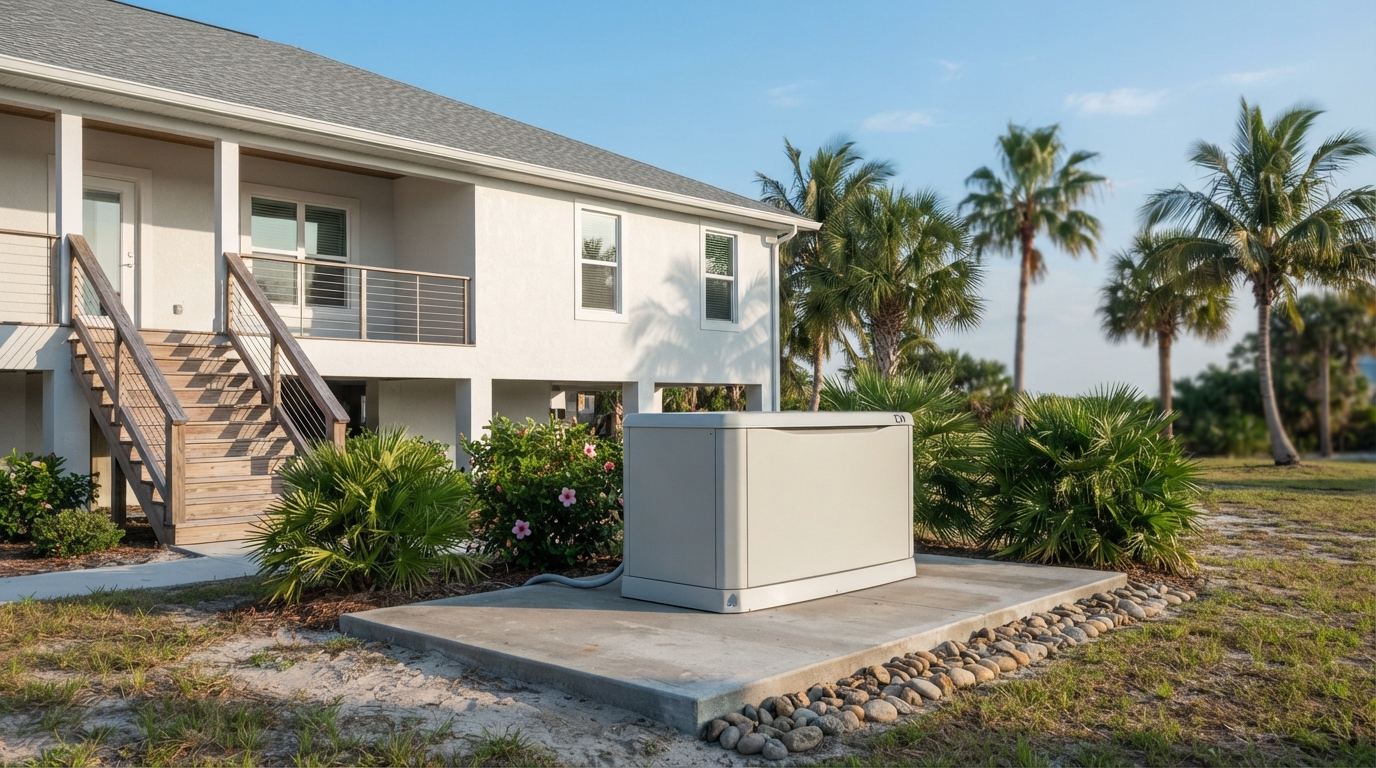
TL;DR: A backup generator only protects your home if it starts when the power goes out. This generator maintenance checklist covers what to check monthly, quarterly, and annually, including the oil, battery, and self-test cycle. Salt air corrodes generator parts faster on Siesta Key than inland, so coastal homes need tighter service intervals than the manufacturer’s minimum. Skipping maintenance is the most common reason a generator fails during a storm. Call Siesta Key Electric at (941) 799-2279 to schedule a professional maintenance visit before hurricane season peaks.
A generator maintenance checklist is the difference between a backup generator that starts the moment the power goes out and one that sits silent during the storm you bought it for. On Siesta Key, that moment tends to arrive during hurricane season, when salt air and humidity have already been working against your generator’s engine, wiring, and enclosure all year.
Most homeowners assume a standby generator takes care of itself once it is installed. It does not. Manufacturers build in a self-test cycle to catch obvious failures, but that test cannot catch a corroded battery terminal, a clogged air filter, or a transfer switch that is starting to stick. Those problems show up during an actual outage, which is exactly when you cannot afford a surprise.
This checklist walks through what a coastal Sarasota County generator needs on a monthly, quarterly, and annual basis, and where salt air changes the schedule most inland maintenance guides never mention.
How Often Should You Service a Home Generator?
Most manufacturers recommend a professional service visit every 100 to 200 hours of run time, or once a year, whichever comes first. On Siesta Key and the rest of coastal Sarasota County, we recommend twice a year: once in the spring before hurricane season begins, and once in late fall after it ends.
Generac’s own maintenance guidance calls for an annual service visit on most residential standby units. That schedule assumes a typical inland installation. Homes on Siesta Key sit inside a salt air corridor that speeds up wear on battery terminals, control boards, and exterior hardware, so an annual visit alone often misses problems that develop mid season.
NFPA 110, the standard that governs testing for standby power systems, also calls for regular exercise cycles and inspection intervals rather than a single yearly check, and that same logic holds even for a residential system that is not legally required to meet the full standard.
Your Generator Maintenance Checklist for Siesta Key Homes
Break maintenance into three timeframes so nothing gets missed between visits.
Monthly
- Confirm the generator’s automatic self-test cycle actually ran and completed without an error code.
- Walk around the unit and clear grass clippings, leaves, and any vegetation growing against the enclosure.
- Check for oil stains or fuel odor near the base, both early signs of a leak.
- Look at the exhaust and intake vents for nests, debris, or insect blockage, common in Florida’s climate.
Quarterly
- Check the oil level and top it off if needed.
- Inspect the air filter and replace it if it looks dirty or discolored.
- Look closely at the battery terminals and any exposed metal hardware for white or green corrosion buildup, a much faster process near the coast.
- Test the battery’s charge, since a weak battery is one of the most common reasons a generator fails to start.
Annually (licensed technician)
- Full oil and filter change, plus a coolant check on liquid cooled units.
- Load bank test, which confirms the generator can actually carry your home’s electrical load, not just start and idle.
- Transfer switch inspection, covered under NEC Article 702 for optional standby systems, to confirm it will switch power correctly during an outage.
- Fuel system inspection, including the propane or natural gas line connections.
If you are still deciding whether a backup generator is worth the investment, our guide to backup generator installation on Siesta Key covers sizing, fuel types, and what a professional installation involves before you ever get to a maintenance schedule.
Why Salt Air Shortens the Life of an Unmaintained Generator
Salt air corrodes exposed metal, wiring connections, and circuit boards faster than almost any other residential environment in the continental United States, and an unmaintained generator on Siesta Key can show real corrosion damage within a single storm season. Corrosion nationwide costs an estimated 3.1 percent of U.S. GDP every year, according to the AMPP Cost of Corrosion Study, and coastal environments like Sarasota County sit well above that average.
A generator’s control board, battery terminals, and transfer switch all involve small metal contact points, exactly the kind of connection salt air attacks first. Left unmaintained, those contact points corrode, resistance builds, and the generator either fails its self-test or trips during an actual outage. This is the same failure pattern behind how salt air affects electrical systems throughout a coastal home, not just the generator.
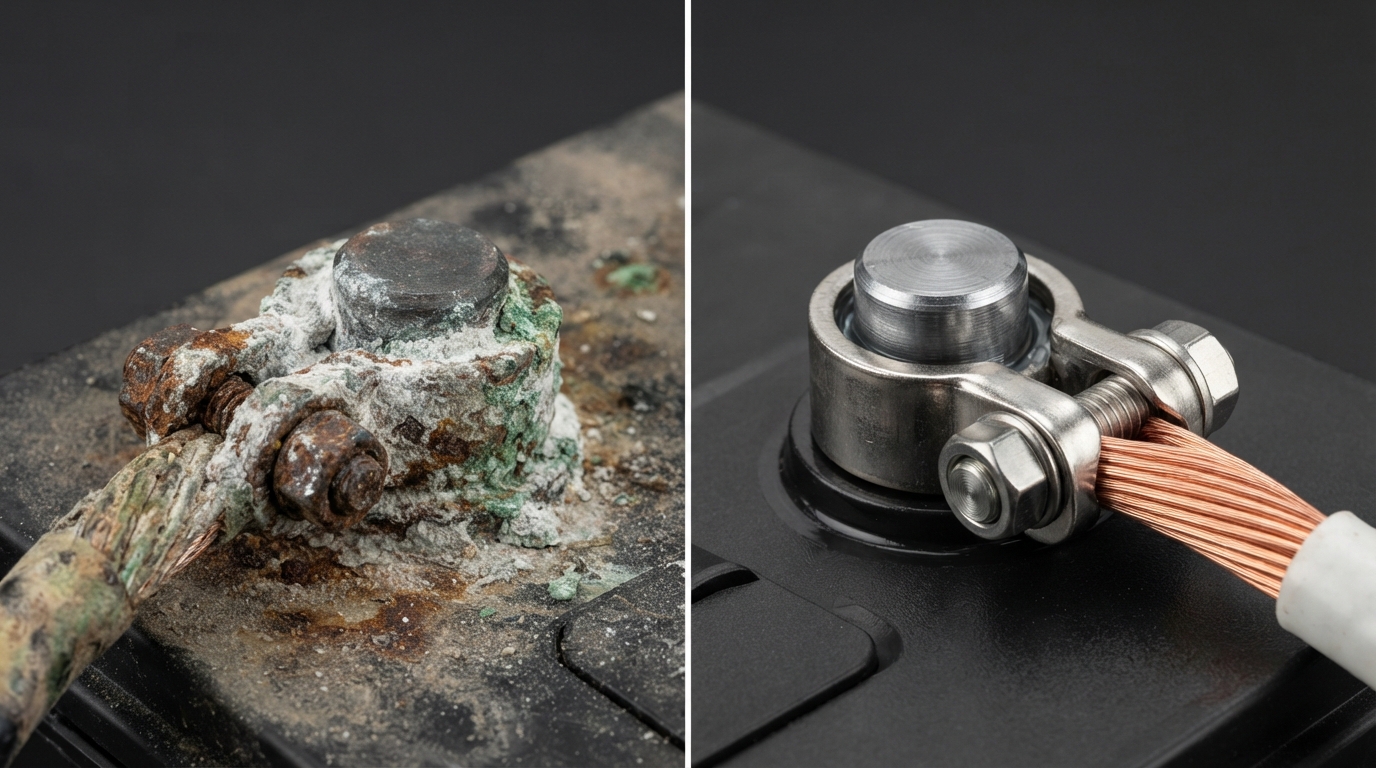
The fix is not a different generator. It is marine-grade electrical hardware and a maintenance schedule built around the coast, not the manufacturer’s inland default. Florida’s own building code recognizes this: the 9th edition requires corrosion-resistant fasteners and connectors in coastal wind zones, the same standard we apply to every generator transfer switch and enclosure connection we install or service on Siesta Key.
Signs Your Generator Needs Professional Service Now
Watch for these warning signs between scheduled visits.
- The self-test cycle fails or shows an error code on the control panel.
- The generator cranks but does not start, or takes noticeably longer to start than usual.
- You notice a fuel smell, unusual smoke, or a knocking sound during the test cycle.
- Visible corrosion, rust, or white powdery buildup appears on the battery terminals, control board, or enclosure hinges.
- The transfer switch hesitates or does not fully engage during a test.
Any one of these is worth a service call before the next outage, not after it.
DIY Maintenance vs. When to Call an Electrician
Homeowners can safely handle the visual and housekeeping side of generator maintenance: clearing debris, checking for leaks, confirming the self-test ran, and keeping the enclosure area clean. Anything involving the transfer switch, wiring, fuel lines, or load testing needs a licensed electrician.
Generators run real household voltage through a transfer switch that is wired directly into your home’s electrical panel. Wiring mistakes here create shock and fire risk, and the Consumer Product Safety Commission has documented how quickly a generator issue can also become a carbon monoxide hazard when ventilation or exhaust components are involved. A load bank test also requires equipment most homeowners do not own and should not need to buy for an annual check.
If a task involves opening the generator’s electrical panel, testing under load, or touching the transfer switch, that is the line between DIY and calling a professional.
Preparing Your Generator Before Hurricane Season
Atlantic hurricane season runs from June 1 through November 30 each year, and the weeks before it starts are the best time to catch problems while you still have options.
Run a full test cycle under load, not just the automatic self-test, so you know the generator can actually carry your home if the grid goes down. Check your fuel or propane supply and top it off before demand spikes ahead of a storm. Confirm the transfer switch engages cleanly, since a switch that hesitates during a calm afternoon test will not improve during an actual storm.
If your generator has not had a professional visit yet this year, schedule one before the season’s first named storm rather than after it. Our hurricane season electrical preparation checklist covers the rest of your home’s storm readiness beyond the generator itself, including surge protection and panel checks. Pair generator readiness with whole home surge protection to guard against the power spikes that come when utility power returns after an outage.
If your home takes on water during a storm, get a professional electrical inspection after flooding before you run the generator again. Floodwater can reach a generator’s control board and wiring even when the unit itself looks fine from the outside.
Generator Maintenance Costs in Sarasota County
A professional generator maintenance visit in Sarasota County typically runs $150 to $400, depending on the generator’s size and how much work the visit includes. A basic inspection and oil change sits at the lower end. A full annual service with a load bank test and transfer switch inspection sits at the higher end.
What that fee should include: an oil and filter change, air filter inspection, battery test, a visual corrosion check on all exposed hardware, a load bank test, and a written summary of anything that needs attention before it becomes a failure. Routine maintenance does not require a Sarasota County permit, unlike a new generator installation, which does.
Keep Your Backup Power Ready
A generator maintenance checklist only works if someone actually follows it. On Siesta Key, that means checking more often than the manufacturer’s inland default and paying close attention to corrosion on battery terminals, control boards, and transfer switches, since salt air works faster here than almost anywhere else in Florida.
The homeowners who never have a generator problem during a storm are the ones who scheduled maintenance before the season started, not after the power went out. If your generator has not had a professional visit this year, now is the time.
Call Siesta Key Electric at (941) 799-2279 to schedule a generator maintenance visit, or request a free estimate online. With hurricane season underway, appointments for pre-storm service fill quickly, so it is worth calling now rather than waiting for the next storm watch.
Frequently Asked Questions
How often should a Generac generator be serviced?
Generac recommends an annual service visit for most residential standby units. On Siesta Key and the rest of coastal Sarasota County, we recommend twice a year, once before hurricane season and once after, since salt air speeds up corrosion beyond what the standard schedule assumes.
Can I do generator maintenance myself?
You can safely handle visual checks, clearing debris around the unit, and confirming the self-test cycle ran. Anything involving the transfer switch, wiring, fuel lines, or a load bank test should go to a licensed electrician, since those tasks involve real household voltage and fuel system components.
What happens if I skip generator maintenance?
An unmaintained generator is far more likely to fail its self-test or not start during an actual outage. Corroded battery terminals, a clogged air filter, and control board issues rarely show symptoms until the moment you need the generator most.
How much does generator maintenance cost in Sarasota County?
A professional maintenance visit typically runs $150 to $400, depending on the generator’s size and scope of service. A full annual visit with a load bank test sits at the higher end of that range.
Does salt air affect my generator’s manufacturer warranty?
Most manufacturer warranties require documented maintenance on the schedule they specify. Corrosion damage from a skipped maintenance interval can be treated as a maintenance issue rather than a covered defect, which is another reason coastal homes benefit from a tighter service schedule than the manufacturer’s minimum.
Need a licensed electrician on Siesta Key? Siesta Key Electric handles home electrical work and commercial electrical service across Sarasota County. Call (941) 799-2279 for a free estimate.