
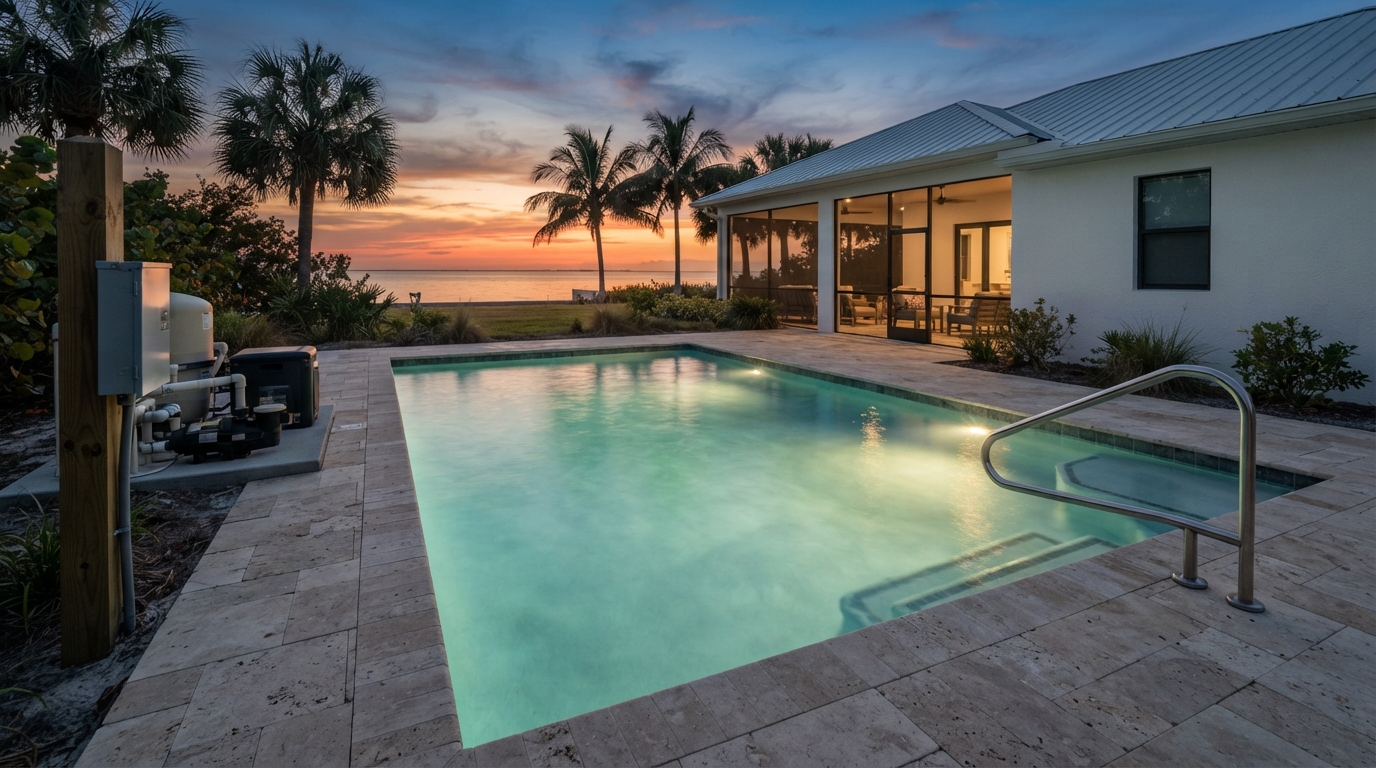
TL;DR: Pool electrical safety on Siesta Key comes down to two things: a working equipotential bonding grid and active GFCI protection on every circuit. Saltwater pools carry about ten times the salt of a standard chlorine pool, and combined with salt air, that speeds up corrosion in bonding lugs and panel connections faster than inland homes ever see. Florida code (NEC 680) sets clear rules for both. Have your pool’s electrical system inspected once a year, and again after any major storm, and call (941) 799-2279 for a free estimate if a GFCI keeps tripping or you have never had the bonding grid checked.
Pool electrical safety matters more on Siesta Key than almost anywhere else in Florida. Most barrier island pools run on saltwater chlorination, and the salt air rolling off the Gulf lands on the same equipment from the outside. That double dose of salt attacks the hidden parts of your pool’s electrical system, the bonding grid and GFCI wiring, years before a mainland pool would show the same wear.
Most homeowners never see this happen. The pool looks fine, the pump runs, the lights turn on. But a corroded bonding lug or a GFCI that has quietly failed removes the one layer of protection standing between your family and a serious shock hazard.
This guide walks through what Florida code actually requires for pool bonding and GFCI protection, why saltwater pools on a barrier island corrode faster than anywhere else, and how often a coastal pool’s electrical system needs a real inspection. Every coastal Sarasota home with a pool should know this before storm season tests it.
What Is Pool Bonding and Why Does It Matter?
Pool bonding connects every metal part near your pool into one electrical system so no part of it can ever carry a different voltage than another. The National Electrical Code requires an equipotential bonding grid made of at least 8 AWG solid copper wire, tying together the ladder, handrails, pump motor, and any metal within 5 feet of the pool’s edge.
Without that bond, a small electrical fault anywhere in the system can leave one metal surface, like a ladder rail, at a slightly different voltage than the water around it. A swimmer touching both at once completes that circuit through their own body.
The grid also has to include the reinforcing steel in the pool shell and the metal housing around any underwater light niche, since both sit in constant contact with the water. On an older Siesta Key pool built before these rules tightened, a licensed electrician can trace and test the existing grid rather than assume it meets current code.
This is why how salt air affects electrical systems on Siesta Key matters just as much for pool equipment as it does for a home’s main panel. Bonding conductors buried near a saltwater pool corrode from both directions: the pool water on one side and salt laden humidity on the other.
Does Florida Code Require GFCI Protection for Pool Equipment?
Yes. Florida’s adopted electrical code requires GFCI protection on every circuit that supplies pool equipment, including pumps, heaters, underwater lights, and any outlet within 20 feet of the water. A qualified GFCI cuts power in about 1/40th of a second once it senses current leaking somewhere it should not be, according to a summary of the requirement from Pool Guard USA.
That speed is the entire point. A person in the water cannot pull away from a shock fast enough on their own, so the breaker has to do it for them.
Underwater lighting circuits need GFCI protection at just 15 volts, a far lower threshold than a standard household outlet. At least one 125 volt receptacle also has to sit between 6 and 20 feet from the pool for maintenance equipment, and it needs the same protection. If you want to understand what a GFCI outlet does in more detail, our GFCI guide covers the coastal side of that question directly.
How Salt Water Pools Accelerate Corrosion of Electrical Components
A saltwater pool holds roughly ten times the salt concentration of a traditional chlorine pool, and that dramatically speeds up galvanic corrosion, the process where dissimilar metals in contact with the water trade electrons and break down. AQUA Magazine reports that nearly every pump and heater has a bonding lug on its casing, which puts that connection directly in the path of the corrosion.
On a mainland saltwater pool, that corrosion works on its own timeline. On Siesta Key, the same equipment also sits in salt laden Gulf air every day of the year, attacking the same metal from a second direction. That combination is exactly why our marine grade electrical installation approach specifies corrosion resistant hardware and sealed connections for coastal pool circuits, not standard inland parts.
Sacrificial zinc anodes help slow this process by giving the corrosive current something else to attack first. Most saltwater pools built without one lose bonding integrity and equipment life years faster than pools that have one installed and replaced on schedule.
Underwater light niches deserve their own attention here. The metal housing sits fully submerged in saltwater around the clock, and the gasket sealing it against water intrusion is one of the first parts to fail once corrosion sets in around the fitting.
Warning Signs Your Pool’s Electrical System Needs Attention
A GFCI that trips repeatedly is not a nuisance to reset and forget. It usually means current is leaking somewhere in the pool circuit, often through a corroded connection or water intrusion into a junction box near the water.
Flickering underwater lights, a pump that hums without starting, or a faint buzzing sound from equipment near the pool deck are all signs worth calling an electrician about right away. Corrosion rarely announces itself with a dramatic failure. It shows up first as small, intermittent problems that get dismissed as old equipment acting up.
Loose or visibly corroded bonding lugs on a pump or heater casing are a clear sign the bonding grid needs a professional check. If your home has a whole home surge protector, review our whole home surge protection guide for how pool equipment fits into that broader picture, since pool pumps and heaters are common casualties of storm related power surges.
Property managers and vacation rental owners on Siesta Key carry an added responsibility here. A pool that sits between renters for a week or two at a time can develop a corroded connection or a failed GFCI with nobody on site to notice, so a proactive inspection schedule matters even more than it does for an owner occupied home. Our property manager electrical services page covers how we coordinate that kind of recurring inspection remotely.
How Often Should You Inspect a Coastal Pool’s Electrical System?
A coastal Siesta Key pool needs a full electrical inspection at least once a year, plus a second inspection after any hurricane or major storm that brought flooding or storm surge near the pool equipment pad. Inland Florida pools can often stretch that interval longer, but salt air exposure does not allow the same margin here.
An annual inspection should include testing every GFCI device, checking the bonding grid for continuity, and looking for corrosion at every accessible connection point. This is the same discipline covered in our hurricane season electrical checklist, which every coastal homeowner should walk through before June each year.
Waiting until a GFCI fails or a breaker trips means the corrosion has already progressed past an easy fix. Catching it during a scheduled inspection is almost always less expensive and far safer.
What Permits Do You Need for Pool Electrical Work in Sarasota County?
Sarasota County requires a permit for pool electrical work performed under the county’s adopted 2020 National Electrical Code and the 2023 Florida Building Code, 8th Edition, according to the Sarasota County Building Division. That permit process includes plan review and inspection at key stages of the work, not just a final sign off.
Any bonding, GFCI, or panel work tied to a pool needs to go through a licensed electrical contractor who pulls the correct permit and schedules those inspections. Skipping the permit on pool electrical work is one of the more common issues we see on resale inspections for waterfront and luxury properties, and it can complicate a sale later.
If you are planning new construction or a major renovation, our luxury waterfront home electrical guide walks through how pool electrical work fits into a larger coastal project from permitting through final inspection.
Protecting Your Investment Starts With the Parts You Cannot See
Pool bonding and GFCI protection are not visible once the work is finished, and that is exactly why they get overlooked. A corroded bonding lug or a failed GFCI looks no different from the outside than a system working exactly as designed.
Three things matter most for Siesta Key pool owners: schedule an annual electrical inspection, add a post storm check every hurricane season, and use an electrician who understands what a saltwater pool combined with Gulf Coast air actually does to bonding and GFCI hardware over time. That combination is unique to barrier island properties, and it is exactly the kind of work the Siesta Key Standard was built around.
Hurricane season runs through November, and storm surge and flooding near a pool equipment pad are two of the fastest ways to compromise bonding and GFCI protection without any visible warning. Call Siesta Key Electric at (941) 799-2279 for a free estimate on a full pool electrical inspection before your next storm, or before you host your first pool party of the season.
Planning a spa next to the pool? Our guide to hot tub and spa electrical wiring covers the NEC Article 680 rules and the coastal failure points we see on Siesta Key.
Pool owners on Bird Key can find dock, lift, and outdoor power details on our Bird Key electrician page.
Frequently Asked Questions
Does Florida code require GFCI protection for pool equipment?
Yes. Every circuit supplying pool pumps, heaters, underwater lights, and nearby outlets must have GFCI protection under the electrical code Florida has adopted. Underwater lighting needs protection at just 15 volts, and any outlet within 20 feet of the pool needs it as well.
What is pool bonding and why does my Siesta Key pool need it?
Pool bonding ties every metal component near the pool, including ladders, rails, and pump motors, into one equipotential grid so no part of the system can carry a different voltage than another. Without it, a small fault anywhere in the system can create a shock hazard a swimmer would never see coming.
How does a saltwater pool affect my electrical equipment differently than a chlorine pool?
A saltwater pool holds roughly ten times the salt of a standard chlorine pool, which speeds up galvanic corrosion in bonding lugs, panel connections, and metal fixtures. On Siesta Key, that saltwater exposure combines with salt laden Gulf air attacking the same equipment from outside, which is not a factor for inland saltwater pools.
How often should you inspect a coastal Sarasota pool’s electrical system?
Once a year at minimum, with an additional inspection after any hurricane or storm that brought flooding near the pool equipment pad. Salt air exposure on Siesta Key does not allow the longer intervals that work for inland Florida pools.
What permits do I need for pool electrical work in Sarasota County?
Sarasota County requires a permit under its adopted 2020 National Electrical Code and 2023 Florida Building Code for pool electrical work, including plan review and inspections at key stages. A licensed electrical contractor should pull that permit and handle the required inspections directly.
Need a licensed electrician on Siesta Key? Siesta Key Electric handles home electrical work and commercial electrical service across Sarasota County. Call (941) 799-2279 for a free estimate.