
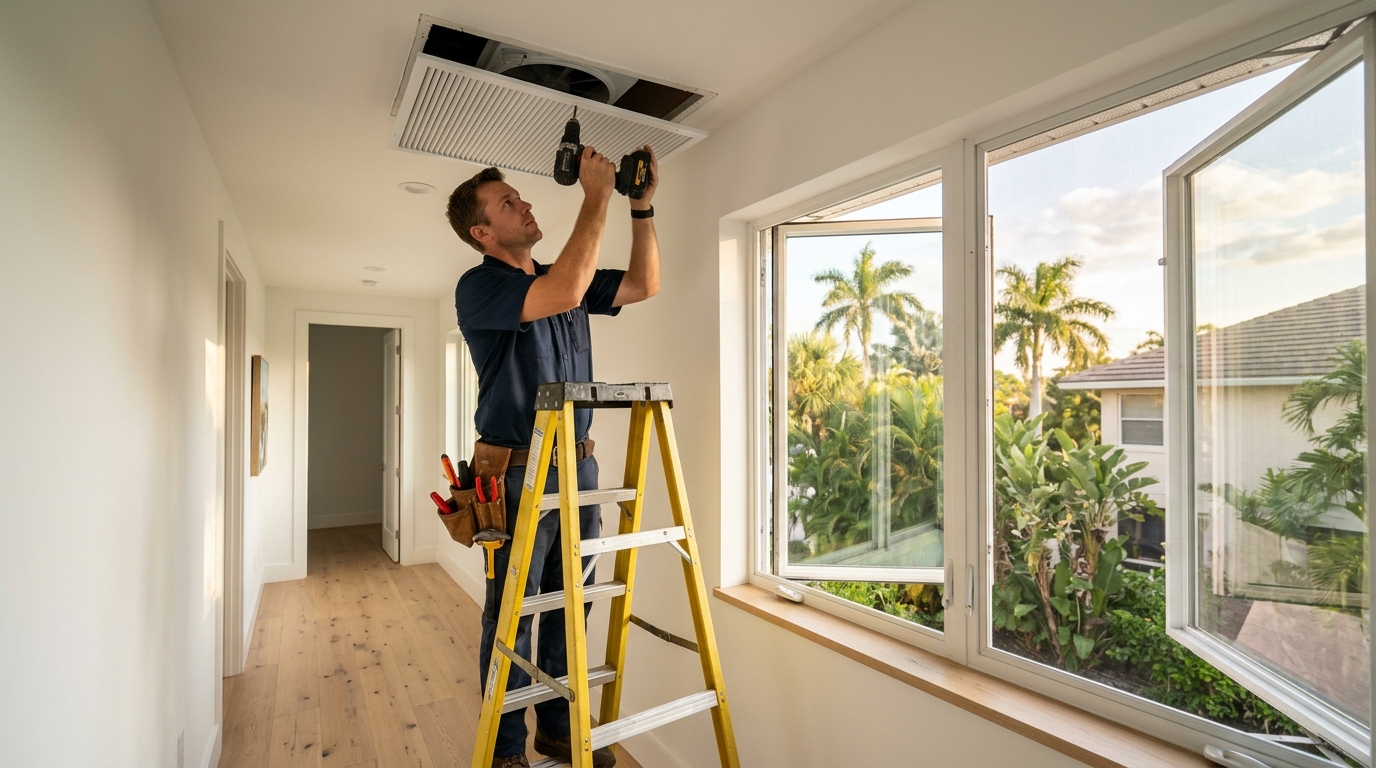
Whole house fan installation costs between $1,045 and $1,899 in Sarasota, FL, according to national pricing data from Homewyse, with most of that total going to the fan unit, the attic mounting work, and the dedicated electrical circuit. Siesta Key Electric installs these fans across Sarasota County and sees the final price move with attic access, ceiling framing, and how far the new circuit has to run from the panel. Florida’s humidity and hurricane exposure also change how this fan should be installed, which is the part most national cost guides skip entirely.
What a Whole House Fan Actually Does
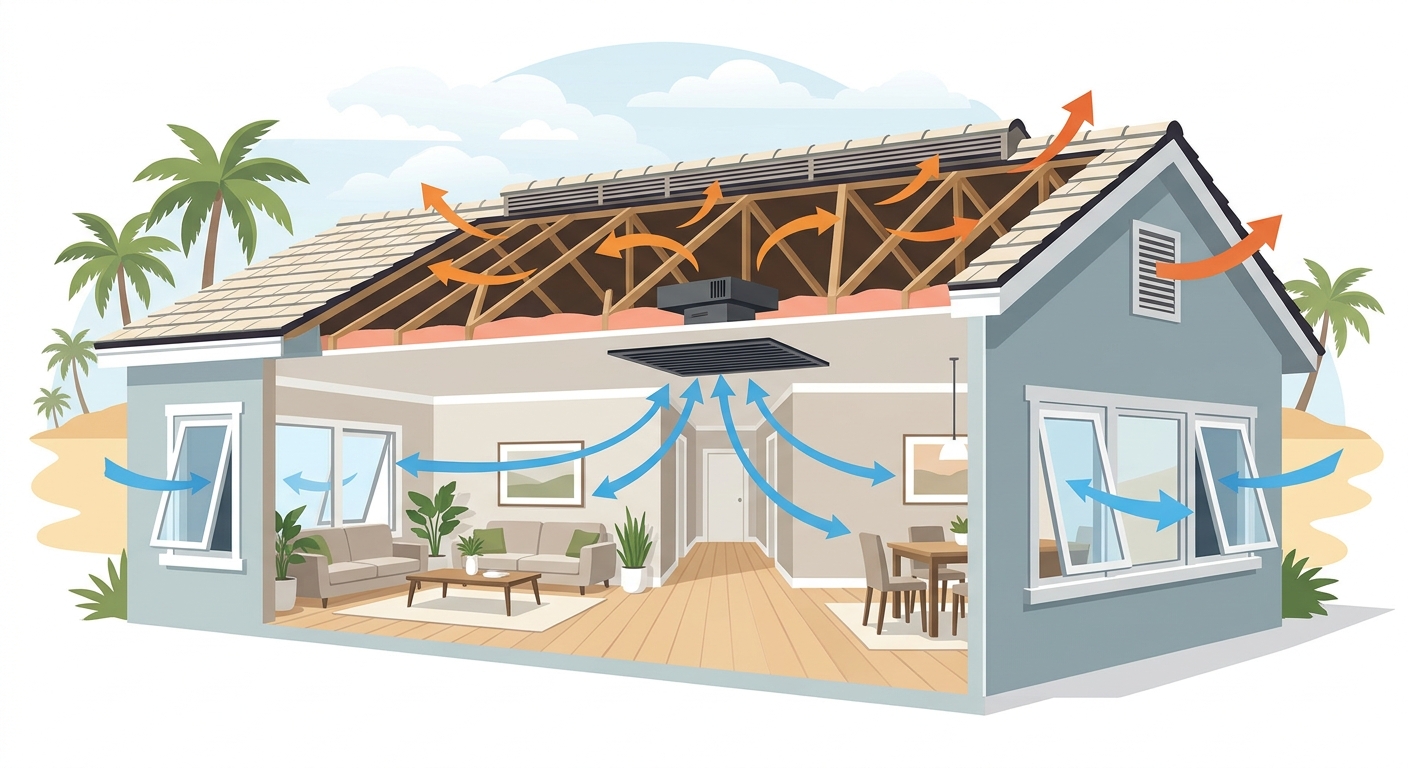
A whole house fan sits in the attic floor, usually above a central hallway, and pulls air from open windows through the living space and up into the attic. From there it pushes that air out through the attic’s existing roof vents, ridge vents, or gable vents. The fan does not create new airflow paths. It relies on the attic’s current ventilation to exhaust the air it moves, so the vent area already up there decides how well the system performs.
This is different from an attic fan, which only moves air inside the attic space and never touches the living areas below it. A whole house fan is sized to the square footage of the home, not just the attic, and it runs on its own switch rather than a thermostat.
Whole House Fan Installation Cost in Sarasota
Homewyse prices a single whole house fan installation between $1,045 and $1,899, covering the fan unit, basic installation labor, and the fittings and mounting hardware the job needs. That range does not include permit fees, inspection fees, or sales tax, and it assumes the attic already has enough exhaust vent area to support the fan.
Three things move a Sarasota installation toward the higher end of that range. A hip roof with limited ridge length often needs added gable or roof vents before the fan can perform correctly. A panel that sits far from the chosen attic location adds wire run and labor. An older home with undersized attic access may need the opening enlarged, which is carpentry work billed separately from the electrical portion.
Whole House Fan vs Attic Fan
Homeowners researching this project often land on attic fan pricing by mistake, since the two products solve different problems. An attic fan is a smaller unit mounted in the roof or gable that only moves air within the attic space, pulling heat off the roof deck so the air conditioner works less hard. It never pulls air from the rooms below it.
A whole house fan does the opposite. It pulls air from open windows through the entire living space, then pushes it into the attic and out through the existing vents. A home can have both, and they solve separate problems: the attic fan manages roof heat year round, while the whole house fan replaces air conditioning on comfortable days when outside air is cooler than the thermostat setting.
Sizing a Whole House Fan for a Sarasota Home
A whole house fan is sized by cubic feet per minute, or CFM, matched to the home’s total square footage rather than to the attic alone. The general rule used in the industry is roughly 2 to 3 CFM per square foot of living space, so a 2,400 square foot Sarasota home typically needs a fan rated between 4,800 and 7,200 CFM to move air through the whole house in a reasonable time.
Undersizing the fan is the most common mistake Siesta Key Electric sees on existing installations. A fan rated below the home’s square footage will run constantly without ever fully exchanging the air inside, which wastes the low operating cost the fan is supposed to deliver. The attic’s existing net free vent area also has to be large enough to exhaust the fan’s full CFM rating, which is the same ventilation math behind the humidity findings below.
The Electrical Work Behind the Price
AirScape, one of the manufacturers Siesta Key Electric installs, specifies a 120 volt circuit drawing between 1 and 2 amps depending on the model, which is a light electrical load on paper. The AirScape installation and operation manual still recommends a dedicated circuit rather than tying into an existing one, so the fan is not sharing capacity with lights, outlets, or an attic air handler that could trip the breaker at the wrong moment.
The manual does not require a licensed electrician for this wiring, only that the installer follow local code and “consult an electrician if necessary.” In practice, most Sarasota homeowners hire one anyway, since the job involves running a new circuit through a hot attic, landing it correctly at the panel, and switching it where the homeowner actually wants to reach it. A residential electrician in Siesta Key also checks the attic wiring already up there before adding anything new, which catches problems a fan installer working alone would miss.
Does a Whole House Fan Help or Hurt in Florida’s Humidity
National guides written for drier, colder climates treat more attic ventilation as an automatic win. Florida’s own building science research does not support that claim for hot, humid regions. The Florida Building Commission’s attic ventilation report states plainly that the standard 1 to 300 ventilation ratio comes from cold climate moisture and ice dam research, not from any study showing it controls moisture in a hot humid climate.
The same report cites a Florida Solar Energy Center test where raising attic vent area from a 1 to 300 ratio to a 1 to 150 ratio actually pushed attic relative humidity up, from 53 percent to 62 percent. More open vent area let more of Sarasota’s humid outside air into the attic instead of drying it out. A whole house fan that runs during the muggiest parts of the day can work against itself for the same reason, so the fan is best run in the early morning or late evening when outside humidity drops.
What a Hurricane Does to Attic Ventilation
The Florida Building Commission report also looked at water intrusion after Hurricanes Frances and Jeanne. Homes with sealed attics saw no water intrusion from those storms. Homes with off ridge vents and open soffit vents were the ones that took on water, since wind driven rain finds any gap in the roof’s exhaust path.
A whole house fan does not seal that path. It uses the vents that are already there. Before storm season, Siesta Key Electric recommends homeowners confirm the fan’s shutter closes fully when it is off, since a stuck or warped shutter is one more opening for wind driven rain to use. The hurricane season electrical checklist covers the rest of the attic and panel items worth checking before June.
Are Whole House Fans Worth It in Sarasota
A whole house fan is worth installing in a Sarasota home that still gets comfortable outdoor air in the spring and fall shoulder months, since pulling that air through the house costs a fraction of what the air conditioner uses to do the same job. The fan is less useful from June through September, when Gulf Coast humidity and heat rarely drop enough overnight to make an open window comfortable.
Homes near the water also see more salt in that outside air, which settles on exposed electrical connections over time. How salt air affects electrical systems in coastal Florida homes explains why a fan’s wiring and switch hardware near Siesta Key benefit from corrosion resistant components that an inland installation would not need.
Pairing a Whole House Fan With Ceiling Fans
A whole house fan works best alongside ceiling fans rather than instead of them. The whole house fan handles the heavy lifting of exchanging the air in the entire home over a few minutes, while ceiling fans keep air moving across each room afterward so the house feels cooler at a higher thermostat setting. Running both together on a mild Sarasota evening often means the air conditioner does not need to run at all.
Sarasota homes updating several rooms at once frequently combine a whole house fan quote with new ceiling fans in the bedrooms and living areas. Ceiling fan installation pricing covers what that part of the project adds, and Siesta Key Electric can quote both as one visit when the attic access and the room wiring are being opened up at the same time anyway.
Permit Requirements for Whole House Fan Installation in Sarasota County
A whole house fan installation almost always needs a permit, since it adds a new dedicated circuit rather than swapping a fixture on an existing one. PermitMint’s Sarasota electrical permit guide confirms that adding a new circuit requires a permit, while routine fixture swaps on existing wiring do not.
Siesta Key Electric pulls the permit as part of the installation and schedules the inspection once the wiring is complete. Skipping the permit on a job like this is also a problem at resale, since an uninspected attic circuit shows up on a buyer’s electrical inspection.
Maintaining a Whole House Fan in a Coastal Climate
A whole house fan near Siesta Key’s open water needs more attention than the same unit installed further inland. The insulated shutter that seals the fan opening when it is off should be checked each spring for warping, since Florida’s attic heat cycles the shutter material through wide temperature swings year after year. A shutter that no longer seals flat lets conditioned air leak into the attic every time the air conditioner runs, working against the fan’s own energy savings.
The motor and switch housing also benefit from an annual check for corrosion, particularly on homes within a mile or two of the water. Siesta Key Electric includes this check as part of the same hurricane season inspection covered in the checklist linked above, since the attic access point used for the fan is the same point used to inspect the rest of the attic wiring.
Frequently Asked Questions
How much does whole house fan installation cost in Sarasota?
Whole house fan installation in Sarasota runs $1,045 to $1,899 for most homes, based on Homewyse national pricing. Attics needing added vent area or a longer wire run from the panel land at the higher end of that range.
Do whole house fans use a lot of electricity?
No. A typical whole house fan draws 1 to 2 amps on a 120 volt circuit, which is a small fraction of what central air conditioning uses to cool the same square footage.
Is a whole house fan bad for a humid climate like Sarasota?
It is not bad, but timing matters. Running the fan during Sarasota’s most humid hours can pull moist outside air into the home, so it works best in the drier morning and evening hours, especially outside of summer.
Does a whole house fan need its own electrical circuit?
The manufacturer strongly recommends a dedicated circuit rather than tying into an existing one, so the fan has stable power and does not compete with other loads on that circuit.
Do I need a permit to install a whole house fan in Sarasota County?
Yes. Adding a new circuit for the fan requires an electrical permit under Sarasota’s rules, unlike a simple fixture swap on wiring that already exists.
What size whole house fan does a Sarasota home need?
Most homes need a fan rated at roughly 2 to 3 CFM per square foot of living space. A 2,400 square foot home typically needs a fan rated between 4,800 and 7,200 CFM, with the attic’s vent area sized to exhaust that full rating.
Need a licensed electrician on Siesta Key? Siesta Key Electric handles home electrical work and commercial electrical service across Sarasota County. Call (941) 799-2279 for a free estimate.