
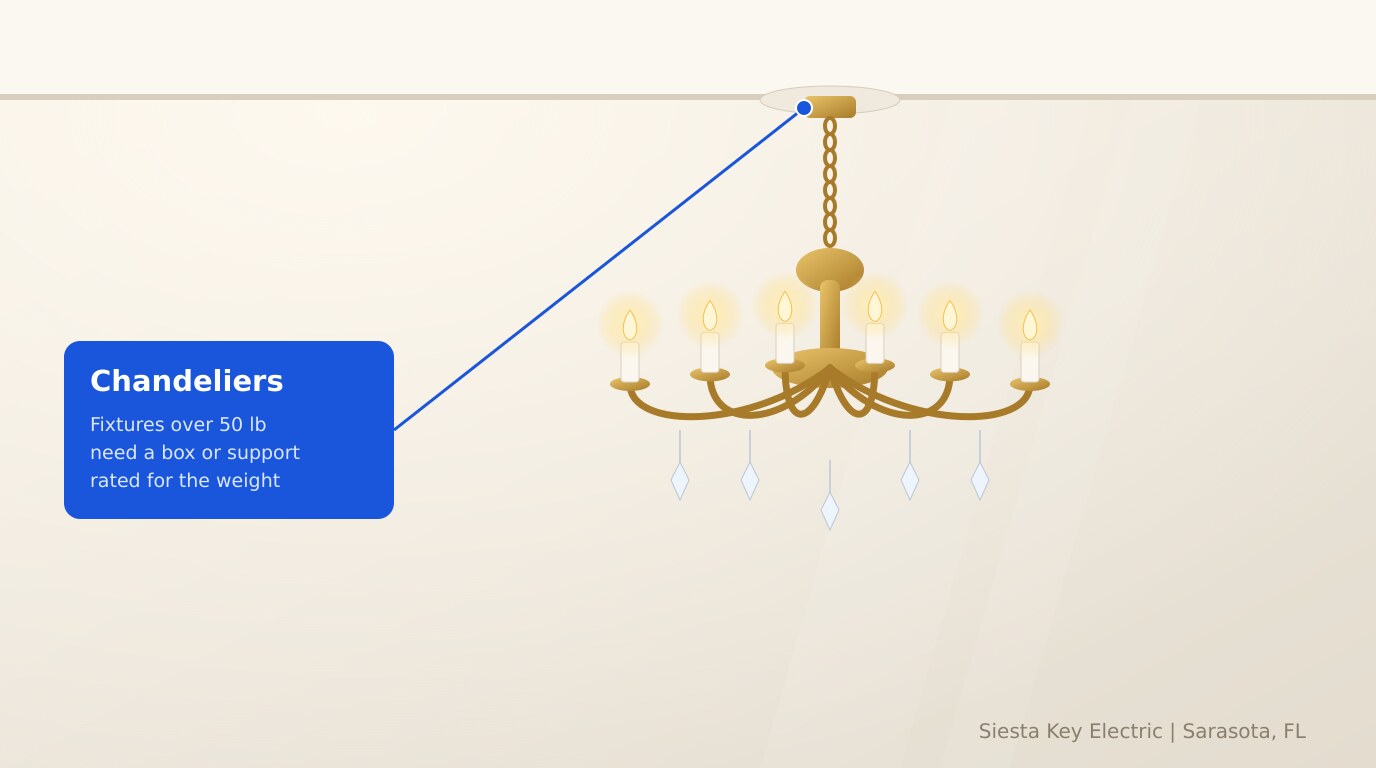
Chandelier installation costs between $368 and $520 for a straightforward swap onto an existing ceiling box, according to Homewyse national pricing data. That range changes fast once a Sarasota home adds a vaulted ceiling, a heavier fixture, or a ceiling box that was never rated to carry a chandelier’s weight in the first place. Siesta Key Electric installs chandeliers across Sarasota County and checks the box, the wiring, and the finish before quoting a job near the water.
What Drives Chandelier Installation Cost in Sarasota
Homewyse’s example estimate of $368.27 to $520.00 covers the fixture swap itself: removing the old light, wiring the new one, and securing it to a box that already supports a ceiling fixture. That figure excludes permit fees, sales tax, and any work needed on the electrical box or the existing wiring.
Three factors push a Sarasota chandelier job above that baseline. A vaulted or two story ceiling needs an extension pole, a longer ladder setup, and often a second technician. A chandelier over 50 pounds needs a box listed for that weight, which may mean replacing the box rather than reusing it. A circuit with a dimmer switch needs a dimmer rated for the chandelier’s actual bulb type and wattage, not just any dimmer already on the wall.
Chandelier Styles Common in Sarasota Homes
Crystal chandeliers remain popular in Sarasota’s formal dining rooms and entries, and their weight comes from the glass or crystal elements rather than the metal frame, which is why an older or smaller frame can still end up over the 50 pound threshold once fully dressed. Linear chandeliers, built for long dining tables and kitchen islands, distribute their weight along a horizontal bar rather than a single center point, which changes how the box and any support bracing need to handle the load.
Coastal style fixtures built from rattan, rope, or wood accents have grown common in Siesta Key’s beach adjacent homes, and these generally weigh far less than crystal fixtures of a similar size. Drum shade chandeliers sit between the two, with most of their weight in the metal frame and socket assembly rather than the shade itself. Knowing the style ahead of the visit lets Siesta Key Electric bring the right box and bracing on the first trip rather than a second one.
Older Wiring and Chandelier Installation
Many homes built in Sarasota County before the 1970s used wiring methods that do not meet today’s standards for a heavier fixture. Aluminum branch wiring, common in homes built in the late 1960s and early 1970s, needs connectors rated specifically for aluminum to avoid a loose, overheating connection at the fixture box. Older cloth insulated wiring found in some of Siesta Key’s original cottages can also be brittle enough that disturbing it during a fixture swap cracks the insulation.
Siesta Key Electric checks the wiring at the box, not just the box itself, before hanging anything heavier than the fixture that is coming down. A chandelier installed on wiring that was never built for the connection it is about to carry is a bigger risk than the box rating alone, and it is the kind of detail that only shows up once the old fixture is actually off the ceiling.
Does Your Ceiling Box Actually Support the Weight
The National Electrical Code sets the rule that decides this, and it is more specific than most homeowners expect. Under NEC Article 314.27(A), a standard ceiling outlet box is presumed to directly support a luminaire weighing up to 50 pounds. Anything heavier needs a box that is specifically listed and marked for that greater weight.
There is a common exception that gets misquoted. A 6 pound weight allowance tied to a device box and a plaster ring, wired with 6 to 32 screws, applies only to wall mounted boxes, according to IAEI Magazine’s reading of the code. It does not apply to a ceiling box holding a chandelier. A 40 or 50 pound crystal chandelier common in Siesta Key’s luxury waterfront homes needs a box rated for that weight from the start, not a wall rated exception stretched to fit the ceiling.
How to Tell If Your Ceiling Box Needs an Upgrade
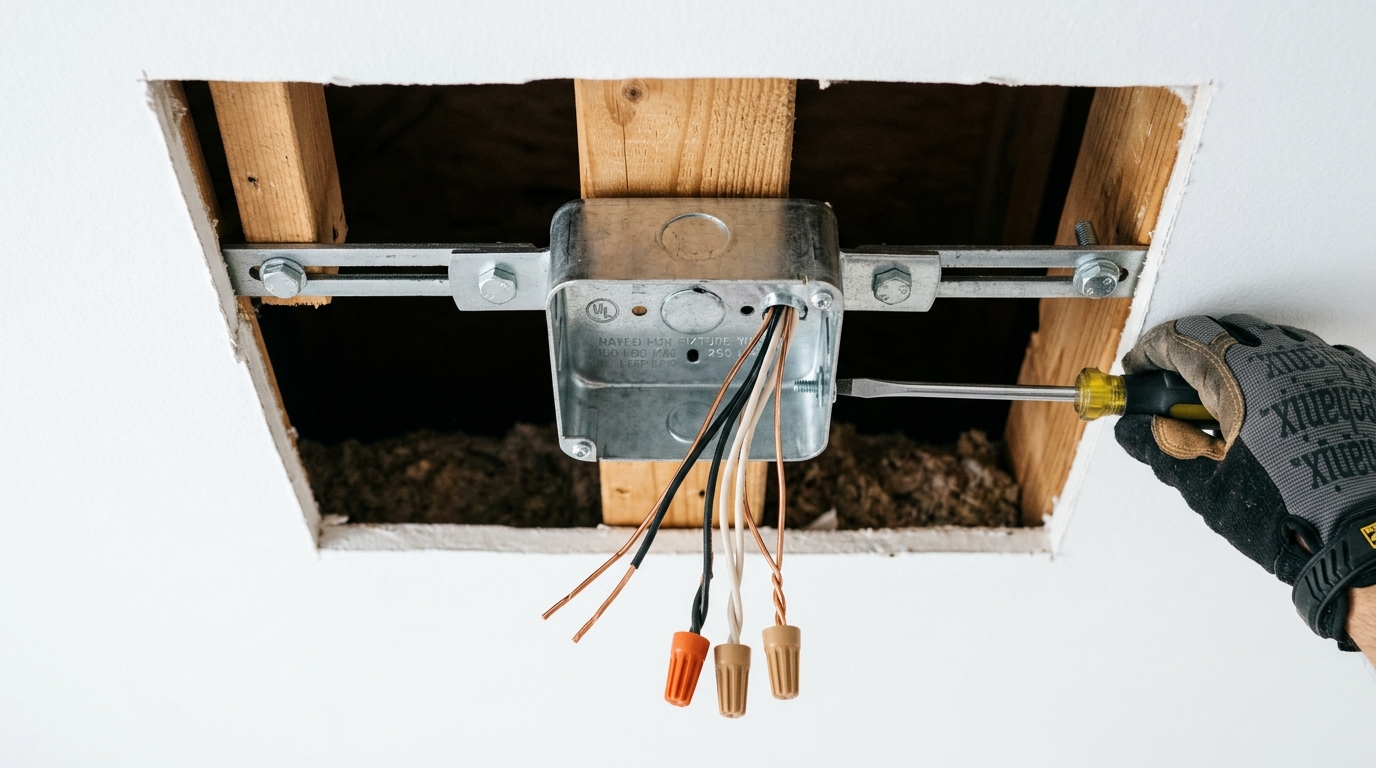
A homeowner can check two things before ever calling an electrician. The existing fixture’s weight, often printed on its original packaging or box, shows whether the current setup already handles something close to the new chandelier’s weight. The box itself, visible once the old fixture is down, should show a listing mark stamped into the metal or molded into the plastic stating its rated weight.
A box with no visible rating, a box that flexes when gently pushed, or a box mounted only to drywall rather than to a joist or a brace bar should be treated as unverified. Siesta Key Electric replaces these with a listed pan box or a joist mounted brace box rated for the new chandelier’s full weight before any wiring goes back in. Reusing an unrated box to save a short visit is the single most common mistake on do it yourself chandelier swaps.
Dimmer Compatibility for Chandeliers
Most chandeliers end up on a dimmer switch, and the switch has to match the bulb type actually installed rather than the fixture itself. LED candelabra bulbs common in chandeliers need a dimmer rated for low wattage LED loads, since a dimmer built for incandescent bulbs will flicker, buzz, or fail to dim smoothly below a certain brightness with LED bulbs.
A chandelier with many small bulbs can also fall under a dimmer’s minimum load rating if every bulb is a low wattage LED, which is why Siesta Key Electric checks the total wattage against the dimmer’s spec sheet rather than assuming any dimmer already on the wall will work with the new fixture.
Installing a Chandelier on a High or Vaulted Ceiling
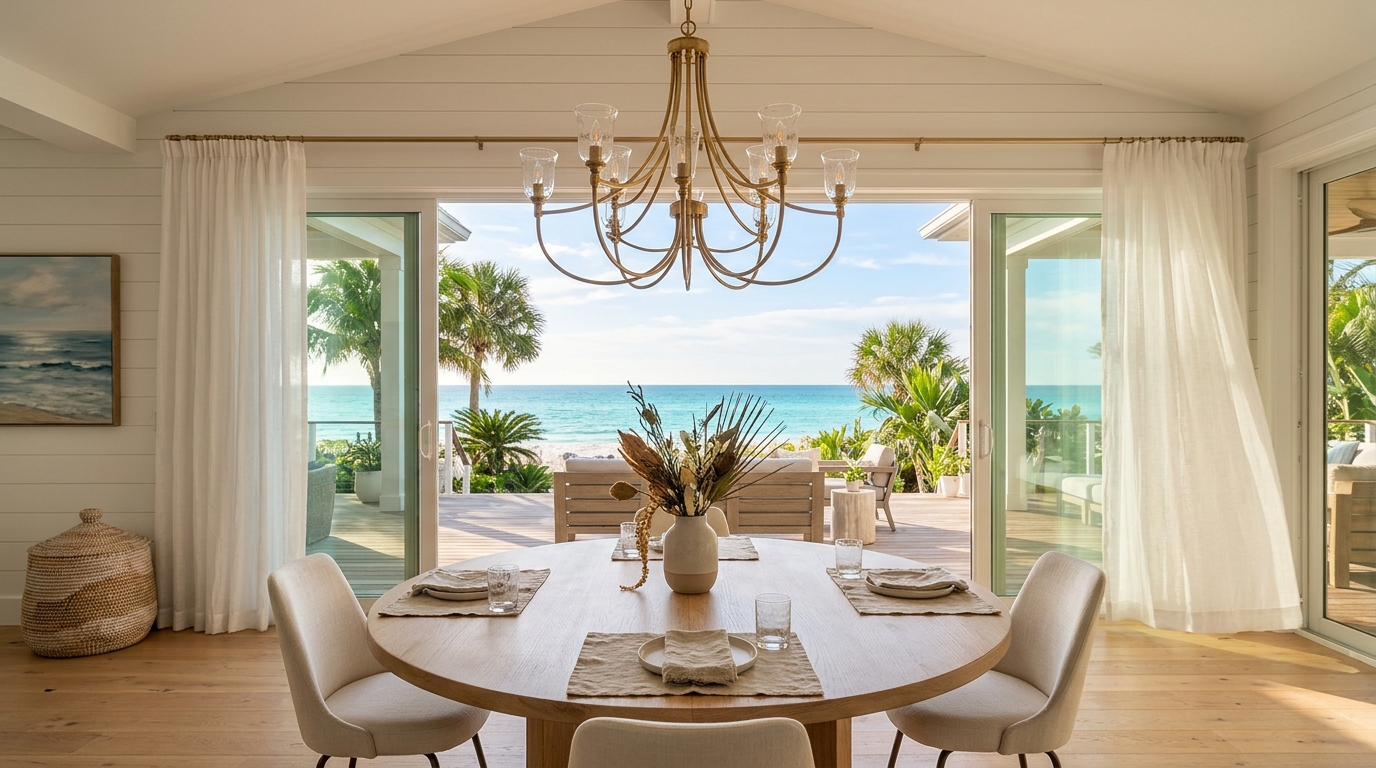
Sarasota’s coastal homes often build to vaulted great rooms and double height entries, which is exactly where chandelier installation gets more complicated. An extension kit or a longer downrod brings the fixture down to a usable height, and that extra length adds pulling force on the mounting box on top of the fixture’s own weight.
Reaching a box 16 or 18 feet up also changes the job itself. Siesta Key Electric uses scaffolding or a lift on these installs rather than a single extension ladder, since a chandelier that size is not something to balance overhead on a ladder’s top rungs. The guide to electrical work in a luxury waterfront home covers more of what changes in these larger coastal properties.
Why Salt Air Changes Which Finish Lasts
A chandelier near Siesta Key’s water faces a problem an inland fixture never sees. Salt carried in coastal air corrodes exposed metal up to 40 miles inland, according to Barn Light Electric, and a chandelier’s finish is the first thing exposed to it every day.
Brass and copper hold up well in that environment because their low iron content resists rust, and both metals develop a protective patina rather than pitting. Porcelain enamel, a glass coating baked onto steel, also resists fading and corrosion better than painted or plated finishes. A chrome or unfinished brass fixture bought for an inland home can show tarnish and spotting within a year of hanging near Siesta Key’s open water.
Chandelier Placement and Height
A chandelier hung over a dining table generally sits 30 to 36 inches above the tabletop, which keeps the fixture visible without blocking sightlines across the table. The same fixture hung in an entryway or stairwell instead needs at least 7 feet of clearance below its lowest point, so nobody walking through has to duck under it.
A room’s ceiling height changes both numbers. A standard 8 or 9 foot ceiling limits how large a chandelier can hang without crowding the room, while Sarasota’s vaulted great rooms can carry a much larger fixture on a longer downrod without feeling oversized. Siesta Key Electric measures the room before the fixture is ordered, not after, since a chandelier that looks right in a showroom can hang too low or too high once it is actually in place.
Do You Need an Electrician for Chandelier Installation
A straightforward chandelier swap onto an existing, correctly rated box is within reach for a confident homeowner, provided the power is off at the breaker and the new fixture matches the old one’s weight and wiring. Hiring a residential electrician in Siesta Key still makes sense for three situations: the ceiling box has never been confirmed to the chandelier’s actual weight, the chandelier needs a dimmer compatible with its bulb type, or the install is on a vaulted ceiling where a fall carries real risk.
A related project worth comparing is recessed lighting installation, which runs on the same household circuits a chandelier often shares and can be priced and scheduled together when a homeowner is updating a room’s lighting all at once.
Permit Requirements for Chandelier Installation in Sarasota
A straight chandelier swap onto an existing ceiling box does not need a permit in the City of Sarasota. PermitMint’s Sarasota electrical permit guide states that replacing a light fixture in an existing location does not require a permit, which covers the typical chandelier swap.
That exemption ends the moment the job adds a new circuit, moves the fixture to a new ceiling location, or upgrades the box itself. Sarasota County permitting follows its own process outside city limits, so a county address should confirm its requirement directly with the Department of Development Services before work starts.
Frequently Asked Questions
How much does it cost to install a chandelier in Sarasota?
A standard chandelier swap onto an existing ceiling box costs $368 to $520 based on Homewyse national pricing. Vaulted ceilings, heavier fixtures, and box upgrades add to that baseline.
Does my ceiling box need to be upgraded for a chandelier?
Only if the chandelier weighs more than 50 pounds. The National Electrical Code presumes a standard ceiling box supports up to 50 pounds directly, and anything heavier needs a box listed for that weight.
Can I install a chandelier myself?
A simple swap onto an already rated box is within reach for most homeowners, with the power off at the breaker. A vaulted ceiling, an unconfirmed box rating, or a dimmer compatible fixture are the three situations worth hiring an electrician for instead.
Do I need a permit to install a chandelier in Sarasota?
No, as long as the chandelier replaces an existing fixture on wiring that already exists. A permit is required if the job adds a new circuit or moves the fixture to a different location.
Does salt air affect chandeliers near Siesta Key?
Yes. Salt carried in coastal air corrodes exposed metal up to 40 miles inland. Brass, copper, and porcelain enamel finishes hold up better near the water than chrome or unfinished plated metals.
How long does chandelier installation take?
A standard swap onto an existing, correctly rated box usually takes one to two hours. A vaulted ceiling install with a lift, a box upgrade, or new wiring can take half a day or longer depending on ceiling height and access.
Need a licensed electrician on Siesta Key? Siesta Key Electric handles home electrical work and commercial electrical service across Sarasota County. Call (941) 799-2279 for a free estimate.