
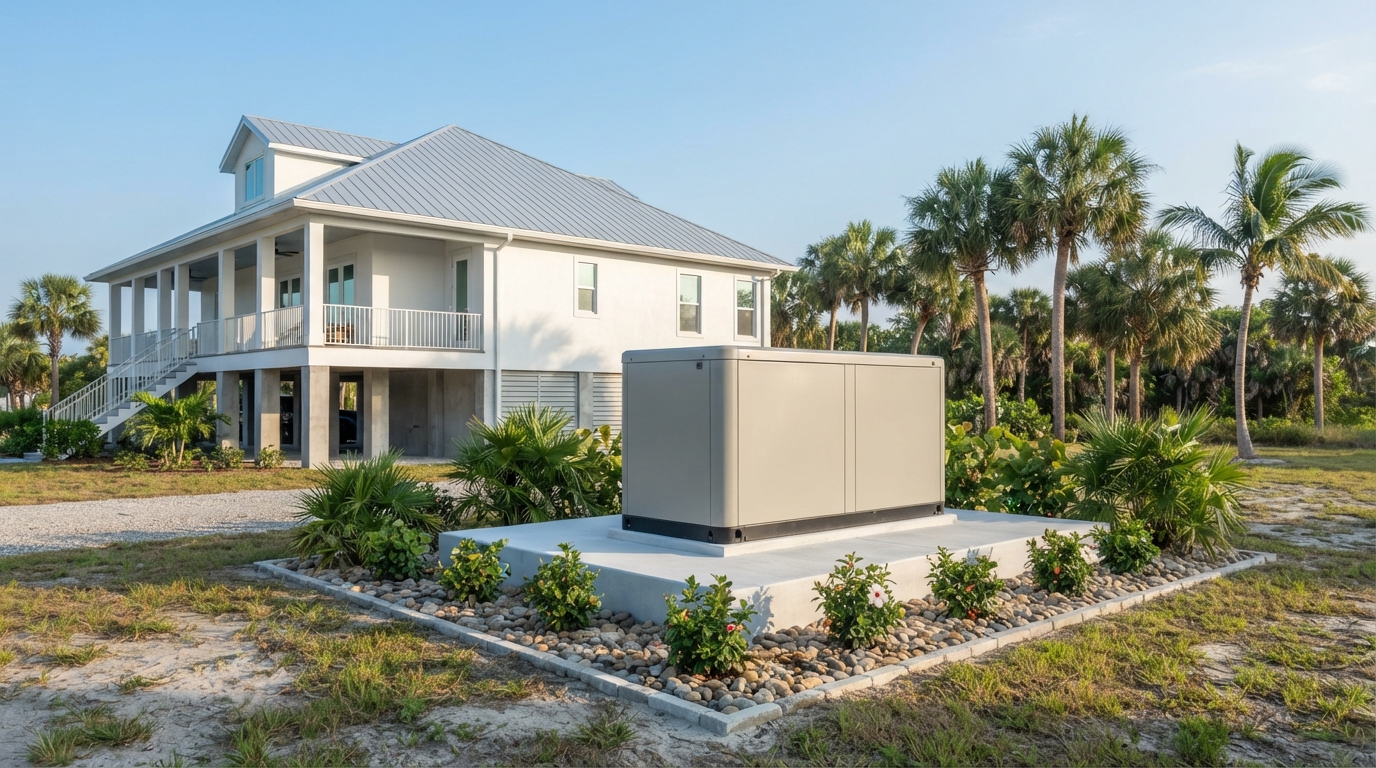
TL;DR: Whole house generator installation cost in Sarasota usually runs about $7,000 to $16,000 for a 12 to 20 kW standby system, and more for larger homes. The total covers the generator, transfer switch, fuel hookup, pad, and permits. On Siesta Key and the barrier islands, plan for coastal extras like a corrosion resistant enclosure, stainless hardware, and flood elevation. Call Siesta Key Electric at (941) 799-2279 for a free estimate.
Whole house generator installation cost in Sarasota depends on three things: the size of the generator, the fuel it runs on, and where your home sits. A mid size standby system usually lands between $7,000 and $16,000 installed, based on unit and labor ranges published by Florida PACE. Larger homes on Siesta Key, Bird Key, and St. Armands often need 22 kW or more, which pushes the total higher.
A home near the Gulf also carries costs an inland home never sees. Salt air attacks exposed metal, and coastal flood zones can require the generator to sit above flood level. Those details rarely show up in national price guides, but they show up on the final invoice.
This guide breaks down each cost line in plain numbers. It covers what goes into the install, how fuel type changes the price, what Sarasota County requires, and how to size the unit.
Siesta Key Electric is a family owned, licensed electrical contractor serving Siesta Key and Greater Sarasota County. We handle the electrical side of every standby install, from the load calculation to the transfer switch to the permit.
How Much Does Whole House Generator Installation Cost in Sarasota?
Whole house generator installation cost in Sarasota typically falls between $7,000 and $16,000 for a 12 to 20 kW standby system, including the unit and the installation. Smaller 7 to 10 kW systems start near $5,000 installed. Homes that need 22 kW or more should plan for $12,000 to $20,000 or higher, before any coastal adders.
Those totals combine two parts: the generator itself and the work to install it. Florida PACE lists the unit prices below and puts installation at $2,000 to $6,000.
| Generator size | Unit cost | Typical fit |
|---|---|---|
| 7 to 10 kW | $3,000 to $5,000 | Essential circuits only, smaller homes |
| 12 to 20 kW | $5,000 to $10,000 | Most single family homes |
| 22 to 30+ kW | $10,000 and up | Large homes, multiple AC systems, pools |
| Installation | $2,000 to $6,000 | Pad, wiring, transfer switch, hookup |
National retail data points the same way. The Home Depot reports an average of $6,897 for installation and materials on an air cooled unit, with most installs costing between $5,000 and $12,500.
These are planning ranges, not a quote. Your final price depends on your electrical panel, the distance from the generator to the house, and your fuel source. A free on site estimate from Siesta Key Electric turns the range into a firm number for your specific home.
What Goes Into the Installation Price?
The installation price covers everything between the generator and a working backup system. That includes a mounting pad, an automatic transfer switch, the wiring from the generator to your panel, the fuel connection, and permits. After the generator itself, the transfer switch and the fuel line are usually the largest line items.
A 2026 price guide from Team Adams, a Generac dealer, breaks those items down this way:
| Line item | Typical cost |
|---|---|
| Concrete pad | $300 to $800 |
| 200 amp automatic transfer switch | $800 to $1,500 |
| 400 amp automatic transfer switch | $1,200 to $2,200 |
| Natural gas connection | $500 to $1,500 |
| Propane tank, above ground | $800 to $1,800 |
| Propane tank, underground | $1,500 to $3,500 |
| Permits and inspections | $200 to $600 |
Put those pieces together and the totals add up quickly. Team Adams gives these sample total project costs for complete standby installs:
| Sample total project costs | Generator size | Total installed |
|---|---|---|
| Smaller home, basic backup | 13 kW | About $8,100 |
| Mid size home, whole home backup | 22 kW | About $13,600 |
| Large home, whole home backup | 38 kW | About $21,000 |
Coastal homes on Siesta Key should add the adders covered in the next section on top of these totals.
The automatic transfer switch is the heart of the system. It senses a power outage, disconnects your home from the utility grid, and starts the generator. That disconnection keeps generator power from flowing back onto utility lines, which protects line workers during storm restoration.
Your panel also matters. If your panel is old, full, or undersized, it may need work before a generator can connect safely. Our guide to electrical panel upgrade cost covers that price in detail.
Some homeowners pair a generator with a smart home electrical panel. A smart panel can shut off lower priority circuits during an outage, which can let a smaller generator carry the home.
Coastal Cost Adders on Siesta Key and the Barrier Islands
Coastal homes need a generator built for salt, wind, and water. National price guides skip this part, but it can change your total more than any other factor on a barrier island. These are the adders Siesta Key Electric plans for on every job west of the Intracoastal.
A corrosion resistant enclosure. Salt air eats exposed steel, fasteners, and electrical terminals, as we explain in our guide to salt air electrical damage. Generac’s support documentation states that its air cooled home standby enclosures use corrosion resistant aluminum with a textured epoxy finish. Whatever brand you choose, ask what the enclosure is made of before you buy.
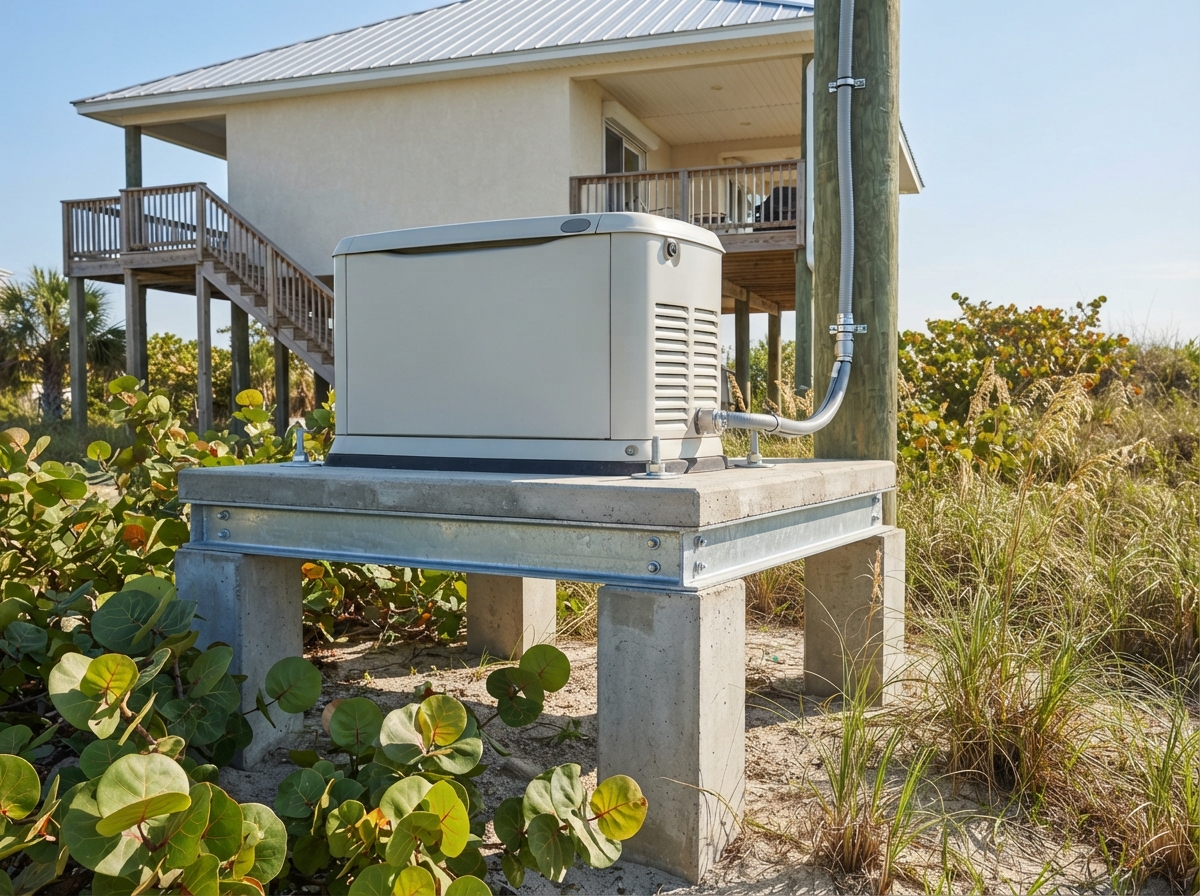
Marine grade hardware. The generator is only one part of the system. Anchor bolts, conduit fittings, the disconnect, and the transfer switch all sit in the same salt air. The Siesta Key Standard means stainless steel hardware, sealed fittings, and corrosion inhibitor on every termination, the same approach we describe in our marine grade electrical installation guide.
Flood elevation. Many Siesta Key lots sit in coastal flood zones. The Florida Building Code, 8th Edition, requires electrical equipment in flood hazard areas to sit at or above the required elevation, according to a Florida Division of Emergency Management summary of Section R322. In V zones and Coastal A zones, that means base flood elevation plus 1 foot or the design flood elevation, whichever is higher.
Meeting that rule often means a raised platform, longer wire runs, and more conduit. The cost depends on how high your lot’s required elevation is.
Wind rating and anchoring. A generator that tips or shifts in a hurricane can tear its own wiring and fuel line loose. Generac rates its air cooled enclosures for winds up to 150 mph, and the pad and anchors need to hold the unit in place just as firmly.
Because these adders vary so much from lot to lot, Siesta Key Electric prices them after a site visit rather than guessing on the phone.
Natural Gas or Propane: How Does Fuel Type Change the Cost?
Natural gas is usually the cheaper hookup when a gas line already reaches your home, at about $500 to $1,500 for the connection according to Team Adams. Homes without natural gas service need propane, which adds the cost of a tank. That makes fuel type one of the biggest swings in the total price.
Team Adams puts an above ground propane tank at $800 to $1,800 and an underground tank at $1,500 to $3,500. The Home Depot reports that propane tank installation can add $5,000 to $8,000 on some projects. The gap between those figures reflects tank size, site work, and whether the tank is owned or leased.
Natural gas runs from the utility, so you never refill it during a long outage. Propane gives you fuel on site, but the tank size sets how many days the generator can run before a refill.
Not every street on Siesta Key has natural gas service, so confirm availability with the gas utility first. A licensed gas contractor handles the fuel line. Siesta Key Electric handles the electrical side and coordinates with the gas contractor so the project runs on one schedule.
What Permits Does Sarasota County Require for a Standby Generator?
A permanently installed standby generator in Sarasota County needs permits and inspections because it connects to your home’s electrical system and a fuel supply. The county enforces the 2023 Florida Building Code, 8th Edition, and the 2020 National Electrical Code, according to the Sarasota County Building Division. Siesta Key Electric pulls the electrical permit on every generator install.
Placement rules also shape the cost. Generac’s clearance guidance, based on NFPA 37, calls for 5 feet from windows, doors, and vents, and 5 feet of open space above the unit. Models tested by Southwest Research Institute can sit 18 inches from a wall. Local code takes priority over those general guidelines.
Clearance rules protect your family from carbon monoxide. Generator exhaust can enter a home through windows, doors, garage openings, and vents, so placement is a safety decision as much as a code one.
HOA homeowners have a helpful protection. Florida Statute 720.3035 counts exterior fixed generators as hurricane protection. An HOA board may not deny an application for hurricane protection that conforms to the specifications the board has adopted.
What Size Generator Does a Siesta Key Home Need?
A common starting rule from The Home Depot is about 3 kW of generator for every 1,000 square feet, and 20 to 24 kW units are its most popular size. By that rule, a 3,000 square foot home starts near 9 kW for basic needs. Central air, a pool pump, and an electric range push many Siesta Key homes toward 20 kW or more.
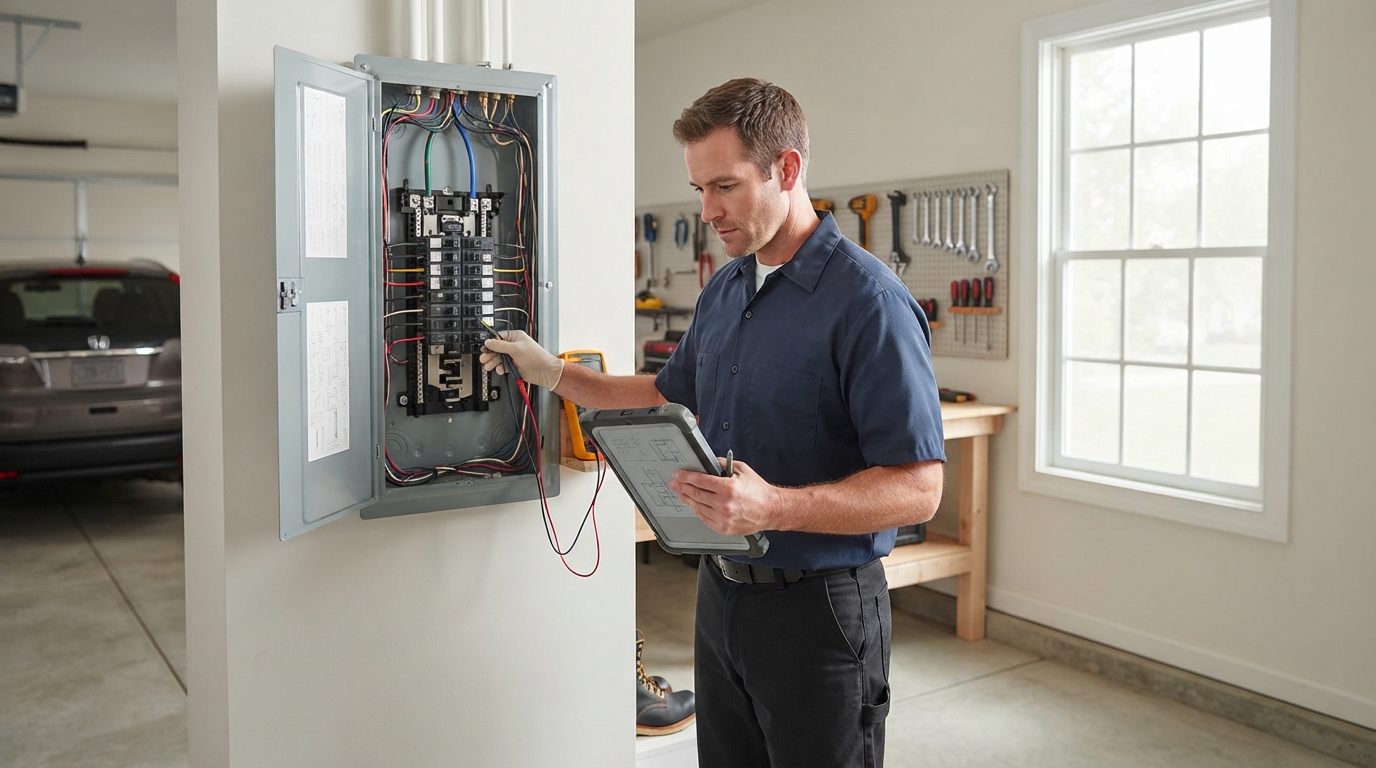
A rule of thumb is only a starting point. Siesta Key Electric runs a load calculation on your actual panel to find the right size. That calculation looks at which appliances must run at the same time, not just the square footage.
You also have a choice between whole home backup and essential circuits. A whole home unit runs everything, including every air conditioner. An essential circuits setup powers the refrigerator, lights, one AC system, and the well or sewage pump, which can cut the generator size and cost.
Some homeowners compare a generator with a battery system before deciding. Our guide to battery backup vs generator walks through runtime, cost, and storm performance side by side.
Ongoing Costs and Ways to Offset Them
The purchase price is not the last cost. A standby generator needs yearly service, and on the coast it needs a closer eye on corrosion. The good news is that some of that cost can come back through insurance savings and avoided storm losses.
Maintenance. Florida PACE puts annual maintenance at $200 to $500. Coastal units should also get a check of the enclosure, terminals, and anchors each year. Our generator maintenance checklist covers what to inspect before and after storm season.
Insurance discounts. Florida PACE cites Consumer Reports in noting that some insurance companies offer a 4% to 10% discount for a whole home generator. Ask your insurer whether your policy qualifies before you buy.
Avoided losses. A closed up home without power can lose food, air conditioning, and humidity control within days. Seasonal residents feel this most. A standby generator keeps the AC and dehumidification running while you are away, which protects finishes, furniture, and air quality.
Financing. Many buyers spread the cost with dealer or lender financing. Compare the total cost of the loan, not just the monthly payment.
Plan Your Whole House Generator Installation Before the Next Storm
Whole house generator installation cost in Sarasota comes down to size, fuel, and site. Most homes land between $7,000 and $16,000 for a 12 to 20 kW system, with larger units and coastal adders on top.
On Siesta Key, the coastal details matter as much as the kilowatts. A corrosion resistant enclosure, stainless hardware, and correct flood elevation keep your backup power working when a storm arrives.
Storm season is still underway, and generator installs take time to permit and schedule. Siesta Key Electric can size your system, price the coastal adders, and handle the electrical permit. Call (941) 799-2279 or request a free estimate today, and learn more about our generator installation services.
Planning to use a portable generator instead? See our guide to generator interlock kit installation for a lower cost way to connect it safely.
Frequently Asked Questions
How long does a whole house generator installation take?
The on site work usually takes a few days once permits and equipment are ready. Permit review and equipment availability often take longer than the install itself. Starting well before storm season gives you the most scheduling room.
Can my HOA stop me from installing a standby generator?
Florida Statute 720.3035 counts exterior fixed generators as hurricane protection. An HOA board may not deny an application that conforms to the hurricane protection specifications it has adopted. Your HOA can still set reasonable specifications, so review them before you choose a location.
Does a generator need to sit above flood level in a Sarasota flood zone?
In many cases, yes. The Florida Building Code, 8th Edition, requires electrical equipment in flood hazard areas to sit at or above the required elevation. In V zones and Coastal A zones, that means base flood elevation plus 1 foot or the design flood elevation, whichever is higher.
Can salt air damage a standby generator?
Yes. Salt air corrodes exposed steel, fasteners, and electrical terminals over time. Generac states that its air cooled enclosures use corrosion resistant aluminum, but the anchors, conduit, and transfer switch still need marine grade hardware and yearly inspection.
Will a whole house generator lower my home insurance?
It may. Florida PACE cites Consumer Reports in noting that some insurers offer a discount of 4% to 10% for a whole home generator. Call your insurance company to confirm whether your policy offers one.