
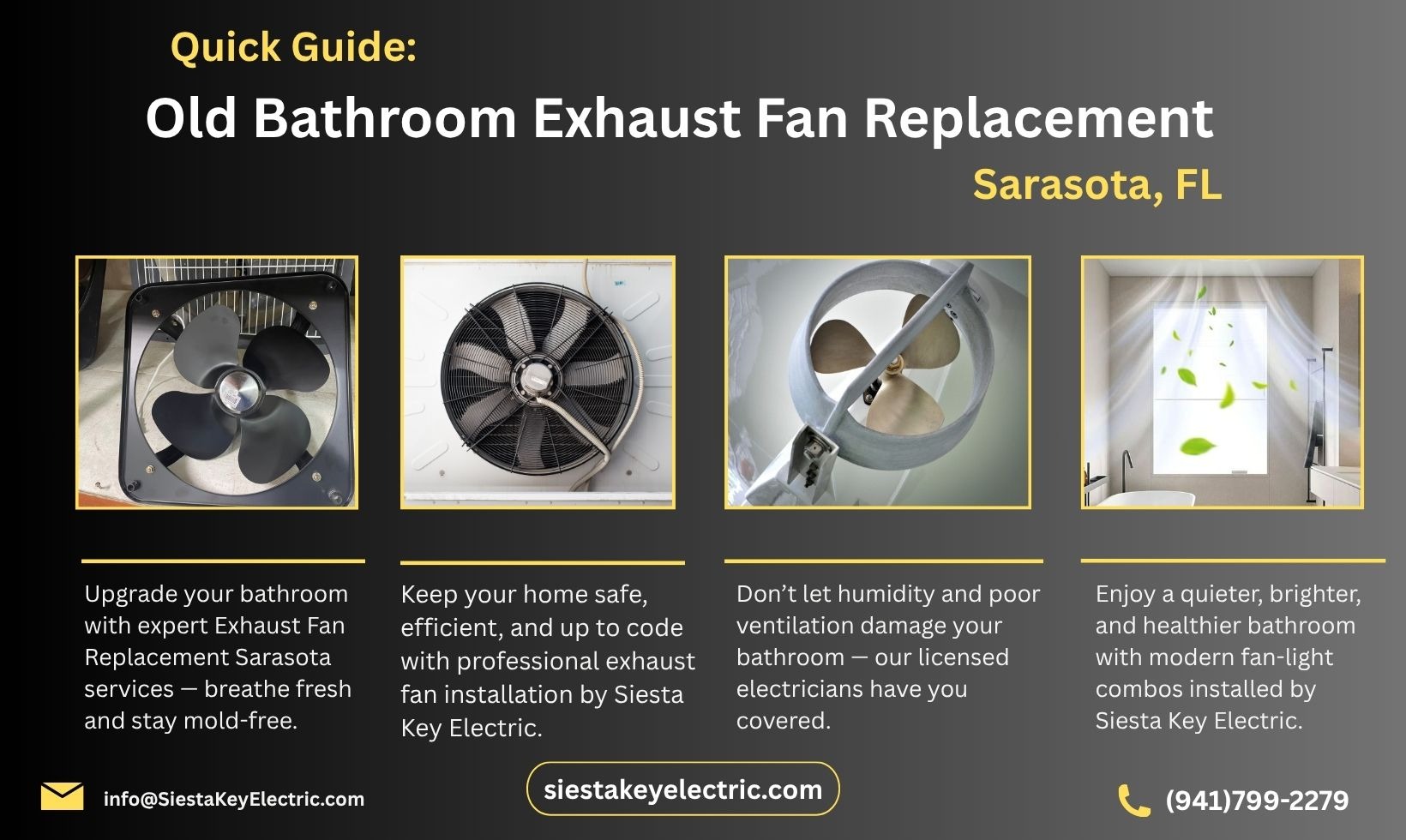
TL;DR: Bathroom exhaust fan installation costs about $241 to $563 for most homes, with a national average of $396, according to Angi’s 2026 data. Swapping an old fan is cheaper than adding a new one with fresh ductwork. In humid, salty Sarasota, a properly sized fan vented outdoors protects your ceiling, wiring, and attic. Call (941) 799-2279 for a free estimate.
Bathroom exhaust fan installation cost depends on one big question: are you replacing an old fan, or adding one where none exists? A straight swap is quick. A new install means cutting a vent, running duct, and often adding wiring.
In Sarasota, that fan works harder than almost anywhere else. Coastal humidity stays high all year, and salt air rides in on every breeze. An old, weak fan lets moisture settle into drywall, framing, and the wiring above your ceiling.
This guide covers real costs, code rules, repair versus replacement, and what coastal homes need to get it right.
How Much Does Bathroom Exhaust Fan Installation Cost in 2026?
Most homeowners pay $241 to $563 to install a bathroom exhaust fan, with a national average of $396, based on Angi’s 2026 cost data from 2,554 projects. The full range runs from $120 for a simple swap to $900 for a new install with venting.
Here is how Angi breaks down the main cost drivers nationally:
| Cost Item | National Range |
|---|---|
| Replacement labor (existing fan and duct) | $100 to $400 |
| New installation labor | $200 to $800 |
| Wall vent installation | $250 to $800 |
| Roof vent installation | $350 to $950 |
| Fan with light (unit only) | $40 to $330 |
| Humidity or motion sensing fan (unit only) | $100 to $400 |
| Inline fan (unit only) | $100 to $310 |
| Electrician hourly rate | $50 to $100 |
Typical Sarasota Project Ranges
Our own projects in Sarasota and Siesta Key usually fall into these ranges. Final pricing depends on attic access, wiring condition, and the fan you choose.
| Service Level | Estimated Cost | Includes |
|---|---|---|
| Basic replacement | $250 to $450 | Swap existing fan |
| New wiring needed | $400 to $750 | Electrical updates |
| Fan and light combo | $450 to $900 | Wiring and fixture installation |
| Premium quiet fan | $600 to $1,200 | High performance model |
These prices are for general reference only. For an exact number, request a free estimate and we will look at your bathroom in person.
Replacement vs New Installation: What Changes the Price?
Replacing a fan that already has a working duct and wiring is the cheapest job, often $100 to $400 in labor. A new installation costs more because it adds a vent through the wall or roof, new duct, and sometimes a new circuit or switch.
These factors move your cost up or down:
- Attic access: an open attic above the bathroom makes the job faster. A second floor bath or flat roof takes more work.
- Vent route: a roof vent costs more than a wall vent, since it needs proper flashing to stay watertight.
- Fan size: a larger housing may mean cutting a bigger opening in the ceiling.
- Wiring condition: corroded or outdated wiring has to be fixed before a new fan goes in.
- Features: humidity sensors, lights, and heaters add to the unit price.
Many older Sarasota fans were never vented outside at all. If yours blows into the attic, the install has to include a proper duct to the exterior.
Bathroom Fan Repair vs Replacement: Which Makes Sense?
Repair makes sense for a newer fan with a minor issue, like a loose grille or a dirty fan blade. Replace the fan if it is over 10 years old, the motor has failed, rust is visible, or airflow stays weak after cleaning.
Watch for these warning signs:
- Loud humming or grinding noises
- Weak suction, or steam that lingers for 20 minutes or more
- Water stains or mold on the ceiling near the fan
- Rust on the grille or housing
- A burning smell or a fan that will not turn on
- A breaker that trips when the fan runs
A burning smell or a tripping breaker is an electrical problem, not just a fan problem. Turn the fan off and call a licensed electrician. Our guide on why a breaker keeps tripping explains what may be going on.
What Size Bathroom Exhaust Fan Do You Need?
Plan for about 1 CFM per square foot of bathroom floor space, with a 50 CFM minimum. For bathrooms over 100 square feet, add 50 CFM for each toilet, shower, and tub. This sizing rule comes from the Home Ventilating Institute, as summarized by Fantech.
| Bathroom Size | Minimum Recommended CFM |
|---|---|
| Up to 50 sq ft | 50 CFM |
| 50 to 75 sq ft | 70 to 80 CFM |
| 75 to 100 sq ft | 90 to 100 CFM |
| Over 100 sq ft | 50 CFM per fixture |
In our humid climate, we often size up slightly. A fan rated under 1.5 sones stays quiet enough that people actually leave it on. A humidity sensing model turns itself on and off, which helps in vacation rentals where guests forget.
What Does the Code Require for Bathroom Exhaust Fans?
Residential code requires bathroom exhaust of at least 50 CFM intermittent or 20 CFM continuous. The air must go directly outdoors, never into an attic or crawl space. Fans over a tub or shower must be rated for damp or wet locations under the electrical code.
The ventilation rules come from the International Residential Code, which the Florida Building Code is based on. Fantech’s code summary quotes it directly: bathroom exhaust “shall not discharge into an attic, crawl space, or other areas inside the building.”
On the electrical side, NEC 410.10(D) covers the zone 3 feet out and 8 feet up from a tub rim or shower threshold. Fixtures in that zone must be marked for damp locations, and wet locations if they sit in the shower spray. Many fan and light combos need GFCI protection by their own listing. Our GFCI guide for coastal homes explains how that works.
Sarasota County may require a permit when the job adds wiring, a new circuit, or a roof penetration. We handle permits on every job that needs one.
Why Coastal Bathrooms Wear Out Fans Faster
Sarasota’s air carries two problems at once: high humidity and salt. Together, they shorten the life of a bathroom fan and the wiring behind it.
Moisture that a weak fan leaves behind condenses inside the housing and duct. Salt in that moisture speeds up corrosion on the motor, terminals, and wire connections. That is why we often find rusted housings and green, corroded wire nuts in fans that are only 8 to 10 years old. Our guide on how salt air affects electrical systems explains the process.
On Siesta Key and the other barrier islands, we follow the Siesta Key Standard:
- Exterior vent caps with backdraft dampers that resist corrosion, so salt air does not blow back down the duct.
- Sealed, insulated duct runs to stop condensation in a hot attic.
- Fresh connections with corrosion resistant hardware, plus an inspection of the circuit feeding the fan.
If we find older aluminum branch wiring during the job, we will flag it. Our guide to aluminum wiring in Sarasota homes covers the safe repair options.
How We Replace an Old Bathroom Exhaust Fan
Every replacement follows the same safety and quality steps:
- Power off and test: we shut off the breaker and verify the circuit is dead with a meter.
- Remove the old unit: housing, motor, and wiring come out without damaging the ceiling.
- Inspect the wiring: we check for corrosion, heat damage, and outdated connections.
- Check the duct: we confirm it runs to the outdoors and replace it if it is crushed or vents into the attic.
- Install the new fan: correctly sized for the room and secured to the framing.
- Seal everything: airtight joints at the housing, duct, and vent cap.
- Test performance: we confirm airflow, noise level, and switch or sensor operation.
Planning a bigger bathroom update? See our list of remodeling projects that need expert electrical work.
Get Your Bathroom Fan Done Right
A new bathroom exhaust fan usually costs a few hundred dollars. Mold cleanup, ceiling repairs, and corroded wiring cost far more. In a coastal home, the right fan, vented outdoors and wired with corrosion resistant hardware, is cheap insurance.
Hurricane season runs through November, and storm humidity pushes old fans to their limit. Now is a good time to fix a weak one before the snowbird season starts.
Call Siesta Key Electric at (941) 799-2279 or request a free estimate. We are family owned, licensed, and insured, serving Siesta Key and all of Sarasota County.
Related reading: For more help with your home, see our guides on DIY versus professional ceiling fan installation and ceiling fan installation pricing in Sarasota.
Frequently Asked Questions
How much does it cost to install a bathroom exhaust fan?
Most homeowners pay $241 to $563, with a national average of $396, according to Angi’s 2026 data. A simple replacement can cost as little as $120. A new install with a roof vent and new wiring can reach $900 or more.
How long does bathroom exhaust fan replacement take?
Most replacements take 1 to 3 hours. The time depends on attic access, the condition of the wiring, and whether the duct needs work. A brand new install with a new vent can take most of a day.
Do I need a permit to replace a bathroom fan in Sarasota?
A like for like swap often does not need one. A permit may be required when the job adds wiring, a new circuit, or a new roof or wall penetration. We confirm permit needs and pull them when required.
Can a bathroom exhaust fan vent into the attic?
No. Residential code requires bathroom exhaust to go directly outdoors, never into an attic or crawl space. In Sarasota’s humidity, attic venting quickly leads to mold, wood rot, and corroded wiring.
Is it worth repairing an old bathroom exhaust fan?
Only if the fan is fairly new and the problem is minor. Fans over 10 years old, with a failed motor or visible rust, are usually better replaced. A new fan also moves more air and runs quieter.
Need a licensed electrician on Siesta Key? Siesta Key Electric handles home electrical work and commercial electrical service across Sarasota County. Call (941) 799-2279 for a free estimate.