
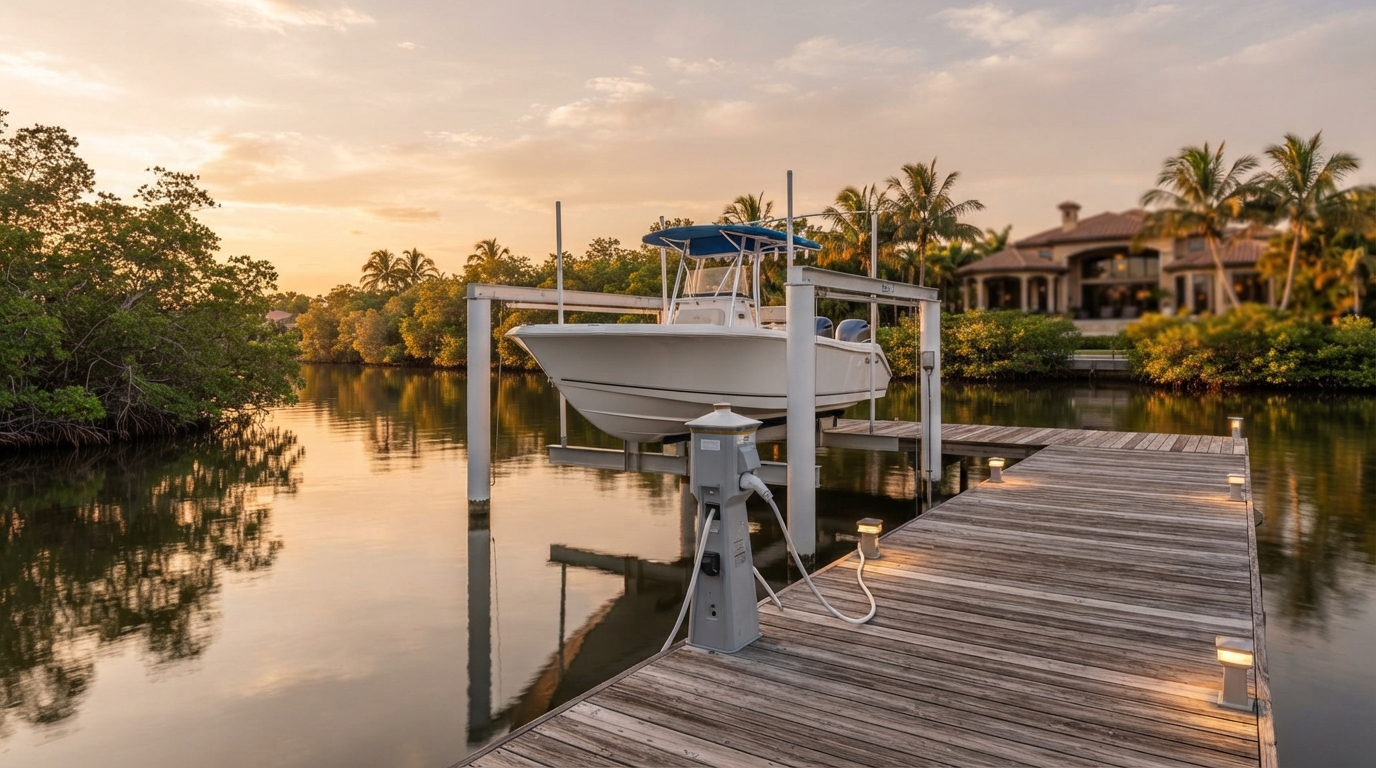
TL;DR: Dock and boat lift wiring is not standard residential electrical work. It involves ground fault protection required by NEC Article 555, marine rated equipment, and connections built to survive constant salt water exposure. Faulty dock wiring can electrify the water around your boat, a hazard called electric shock drowning. Sarasota County requires a permit and inspection for this work. Call (941) 799-2279 for a marine electrical assessment.
Dock and boat lift electrical wiring is some of the most demanding work an electrician does on Siesta Key, and it shares almost nothing with a standard residential job. A dock sits partly in salt water every day, and the wiring that powers your boat lift, dock lighting, and shore power pedestal has to survive that environment without ever failing.
The stakes are higher than corrosion alone. Faulty dock wiring can leak current into the water around your boat or seawall, a hazard called electric shock drowning. It is rare, but it is real, and it is entirely preventable with the right wiring and the right protection.
This guide expands on the dock and boat lift section of our luxury waterfront home electrical guide, covering what this work actually involves, what the code requires, and why the marine environment around Siesta Key demands more than a standard inland installation.
What Does Dock and Boat Lift Electrical Wiring Involve?
Dock and boat lift wiring covers the shore power pedestal that plugs into your boat, the motor and control circuit that raises and lowers a boat lift, and any dock lighting or outlets. All of it runs through conduit rated for wet, corrosive conditions and terminates in ground fault protected panels built for marine use.
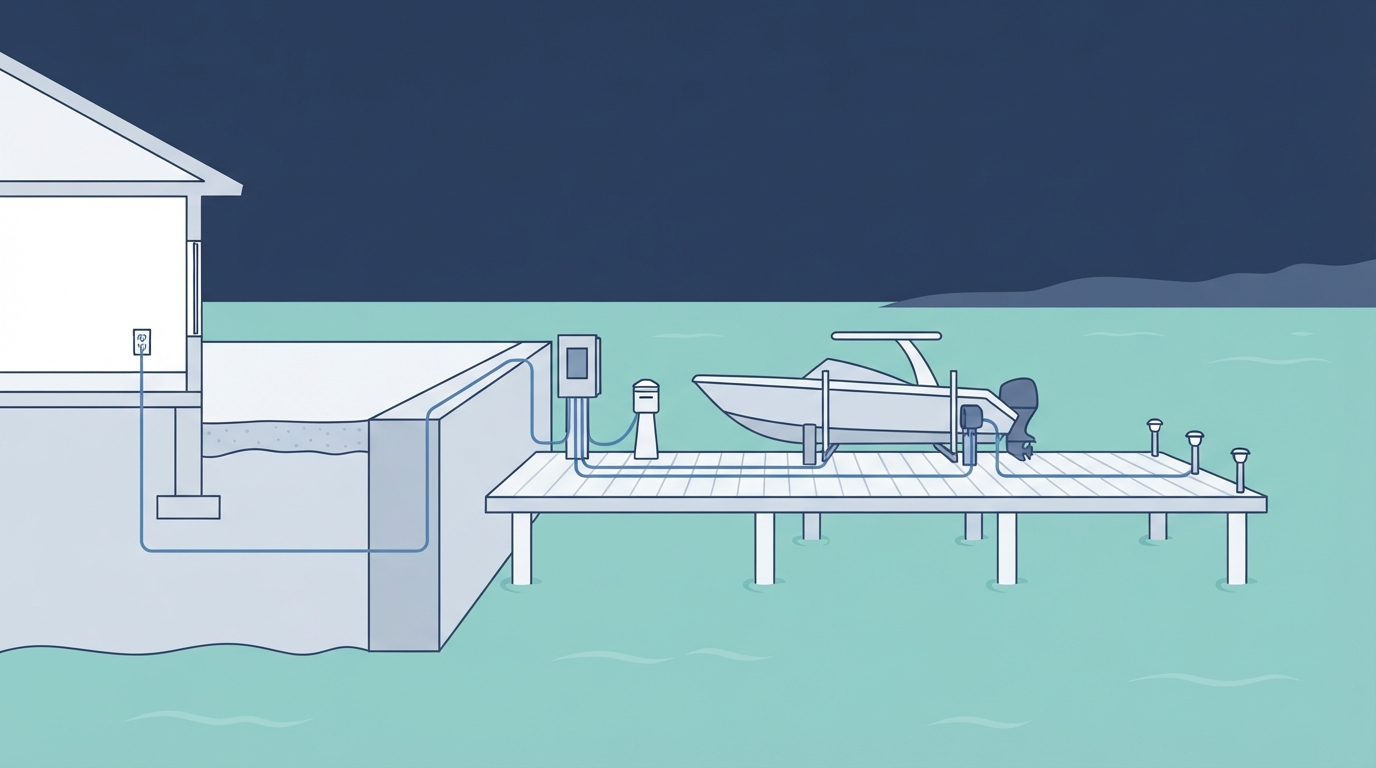
A boat lift motor alone typically needs a dedicated circuit sized to the lift’s horsepower, along with a control switch mounted where you can reach it from the dock. Shore power pedestals add another layer, since they carry enough current to run a boat’s onboard systems and appliances while it is tied up.
The Real Danger: Electric Shock Drowning and Why Dock Wiring Is Different
Electric shock drowning happens when faulty or damaged wiring leaks electrical current into the water around a dock or boat, paralyzing anyone swimming nearby. According to the Electric Shock Drowning Prevention Association, most documented cases happen at marinas and private docks, and there is no visible sign the water is energized.
That last point is what makes dock wiring different from every other job on this list. A bad outlet in your kitchen trips a breaker or stops working. A bad connection on a dock can energize the water itself, and a swimmer has no way to see or sense the danger before it is too late.
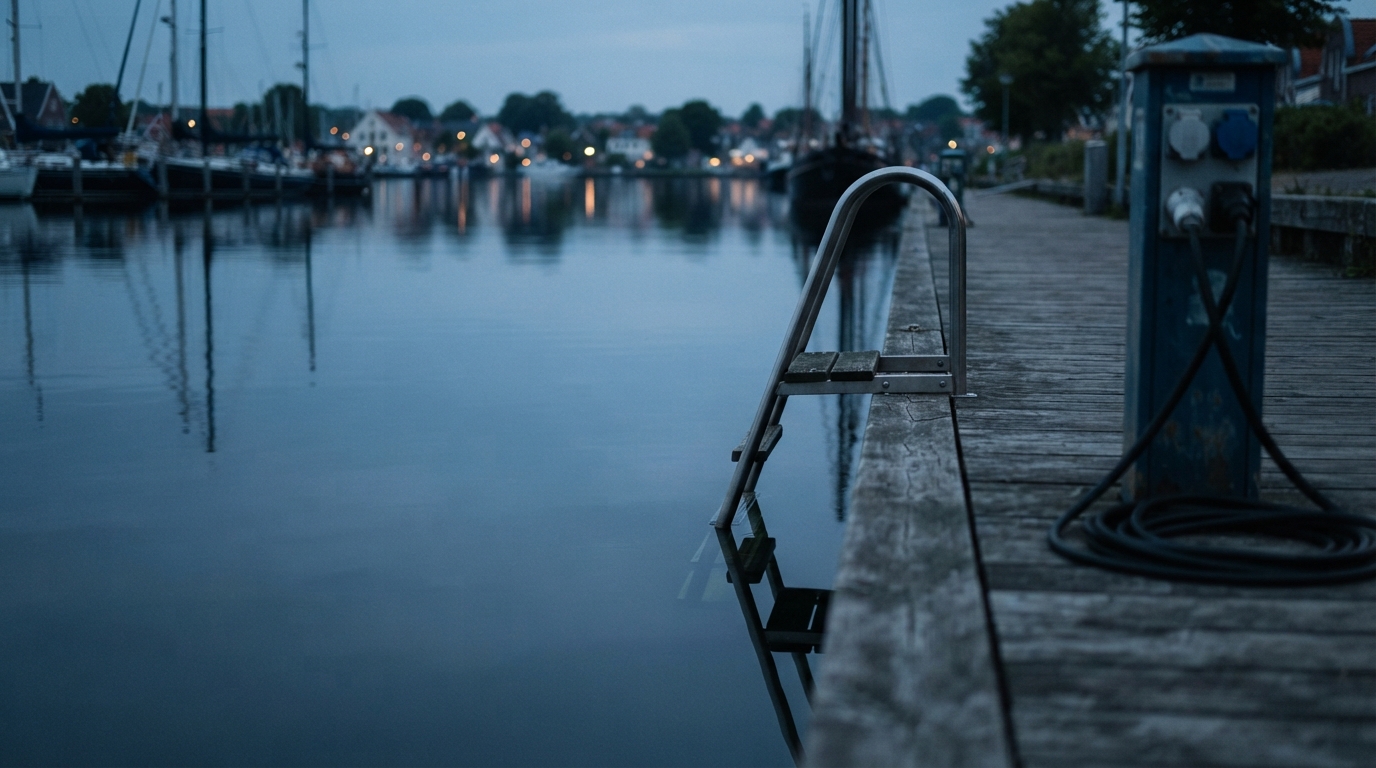
The Electrical Safety Foundation International recommends having dockside electrical systems inspected annually by a qualified electrician and testing GFCI protection monthly, exactly because these faults can develop gradually and go unnoticed until someone is in the water.
What the Electrical Code Requires for Docks and Boat Lifts
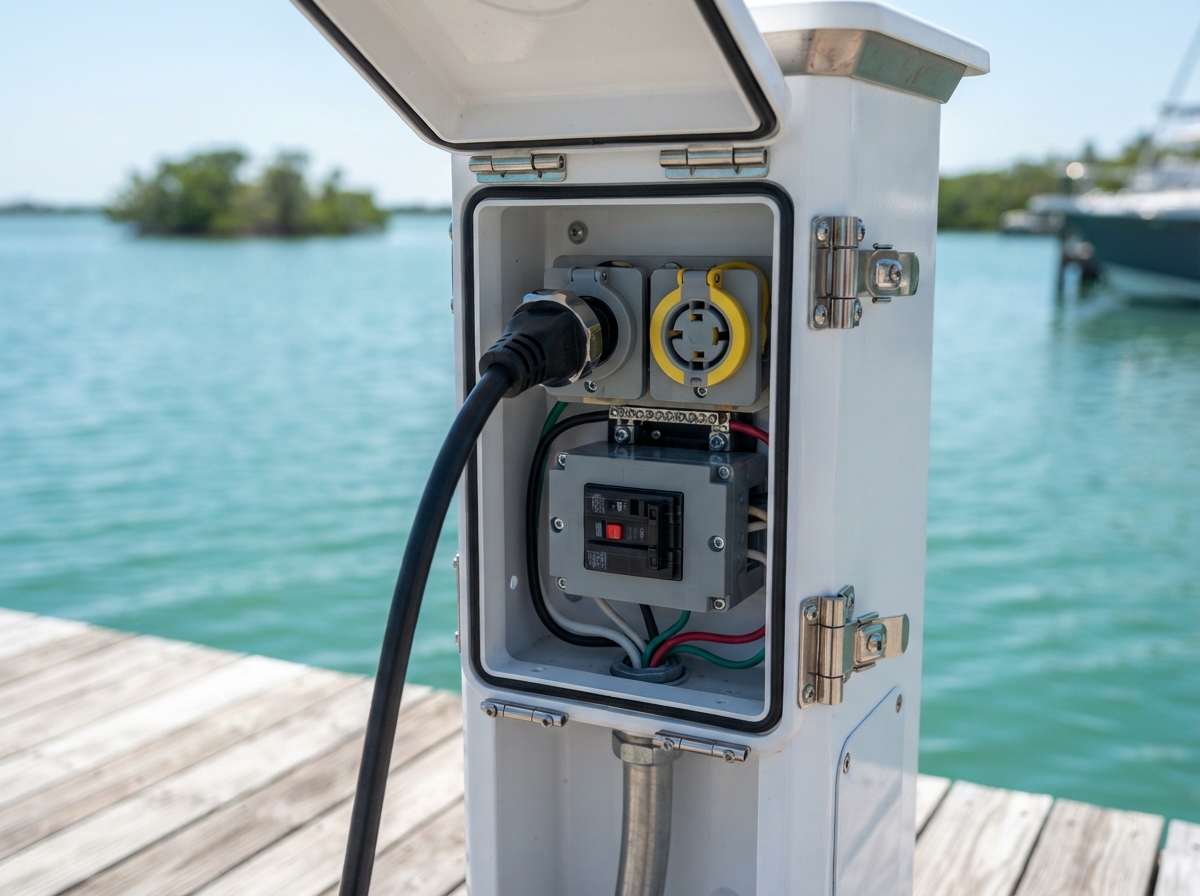
NEC Article 555 governs marinas, boatyards, and docking facilities, and it requires ground fault protection at every level of a dock’s electrical system, not just at the outlets. Every branch circuit on a dock, including the ones powering a boat lift motor, must have its own GFCI protection, and the main feeder from shore must include ground fault protection as well.
Shore power receptacles get the strictest requirement. Every one of them must be GFCI protected, since that outlet is what a boat plugs directly into. This is stricter than the GFCI requirements for a typical outdoor outlet at a house, and it reflects how much more dangerous a fault becomes when it happens over water.
None of this is optional or something a general contractor can add later. It has to be part of the original design, sized correctly for the boat lift and any dock accessories from the start.
Why Standard Residential Wiring Fails in a Marine Environment
A dock sees more corrosion in a single wet season than most house wiring sees in a decade. Salt water splashes, humidity sits at nearly 100 percent most days, and every metal connection point is exposed to direct salt spray, not just the salt laden air that already accelerates corrosion on the rest of a Siesta Key home.
Standard residential grade conduit, connectors, and boxes are not rated for that. Marine electrical work calls for corrosion resistant, marine rated hardware throughout, the same standard we apply to salt air affected wiring anywhere on your property, just built to a higher tolerance for constant water contact.
This is also why a generic inland electrician, even a good one, often gets dock wiring wrong. The failure mode is not a light that flickers. It is corrosion that goes undetected until a ground fault trips, or worse, until it does not trip at all.
Boat Lift Motors, Controls, and Circuits: What’s Involved
A boat lift installation needs a dedicated circuit sized to the lift motor’s horsepower, a weatherproof disconnect switch within sight of the lift, and GFCI protection on that circuit per code. Most residential boat lifts run on a 115 or 230 volt single phase motor, and the exact circuit size depends on the lift’s rated capacity.
The control switch also needs to be mounted somewhere accessible and weatherproof, not tucked against a piling where it takes constant spray. Poor placement is one of the most common issues we find on older dock installations, where a switch installed years ago is now corroded through from repeated exposure.
Permitting and Inspection for Dock Electrical Work in Sarasota County
Dock and boat lift electrical work requires an electrical permit in Sarasota County, separate from any dock construction or seawall permit, and it needs a final inspection before it goes into service. Sarasota County’s Building Division applies the 2020 National Electrical Code to this work, the same baseline used for every other electrical permit in the county.
Skipping the permit is not just a compliance risk. An uninspected dock circuit is exactly the kind of installation most likely to have the ground fault protection gaps that lead to electric shock drowning, since nobody outside the installer ever verified the wiring meets code.
If you manage a waterfront vacation rental, this permit and inspection step matters even more, since guests using the dock have no way to know whether the wiring was ever checked. Our guide for property managers and vacation rental owners covers how we schedule electrical maintenance like this across multiple properties.
How Often Should Dock Wiring Be Inspected?
Have dock and boat lift wiring professionally inspected at least once a year, and test the GFCI protection monthly by pressing the test button on the panel or pedestal. The Electrical Safety Foundation International recommends this same annual and monthly schedule for any dockside electrical system.
On Siesta Key, we recommend leaning toward the more frequent end of that schedule, especially after a named storm has pushed extra salt water and debris across a dock. A quick post storm check catches problems before the next time someone is swimming near the boat.
Get Your Dock Wired the Right Way
Dock and boat lift electrical work is not a place to cut corners or hire the lowest bid. The code requirements exist because the failure mode is not an inconvenience, it is a genuine safety risk to anyone swimming near your dock.
On Siesta Key, that risk compounds with the fastest corrosion environment in the region. Marine rated hardware and ground fault protection sized correctly from the start are what keep a dock safe for years, not just for its first season.
Siesta Key Electric installs and inspects dock and boat lift wiring to NEC Article 555 standards, built with the same marine grade hardware we use across every coastal installation. Call (941) 799-2279 for a free estimate, or request one online.
Related reading: For more help with your home, see our guides on dock and lanai lighting on Siesta Key and automatic gate installation on Siesta Key.
Frequently Asked Questions
Do I need a permit to add electrical to my dock or boat lift?
Yes. Sarasota County requires a separate electrical permit for dock and boat lift wiring, along with a final inspection before the system goes into service.
What is electric shock drowning?
Electric shock drowning happens when faulty electrical wiring leaks current into the water around a dock or boat, paralyzing a swimmer nearby. It is rare but entirely preventable with correctly installed ground fault protection.
How much does it cost to wire a boat lift?
Cost depends on the lift’s horsepower, the distance from your panel to the dock, and whether new conduit needs to run underwater or along a seawall. A licensed electrician can give an exact quote after seeing the site.
Can I use a regular outdoor GFCI outlet on my dock?
No. Dock wiring needs marine rated equipment and GFCI protection at every branch circuit, not just the outlets, per NEC Article 555. A standard residential GFCI outlet does not meet that standard.
How often should I test my dock’s GFCI protection?
Test it monthly by pressing the test button, and have the full system professionally inspected at least once a year, more often after a major storm.